

Quick Answer
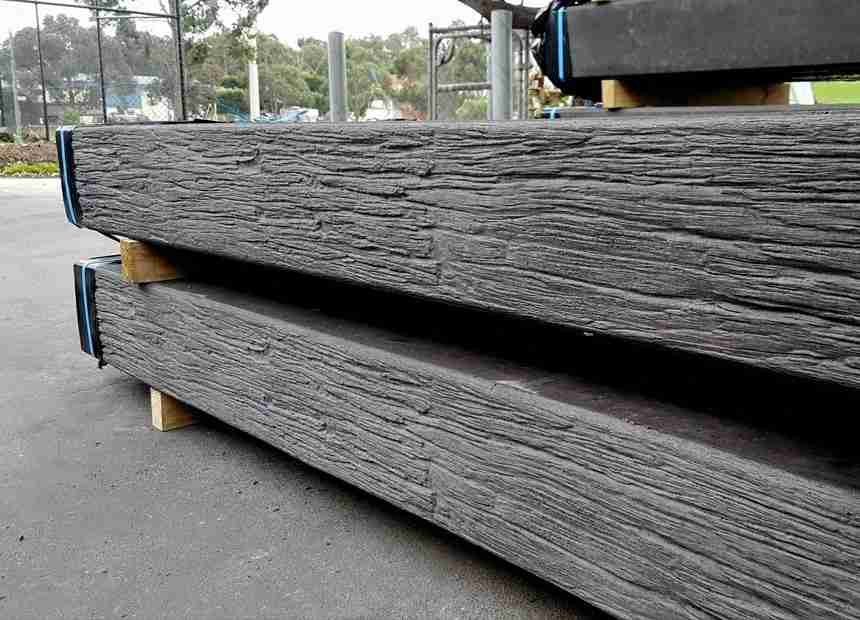
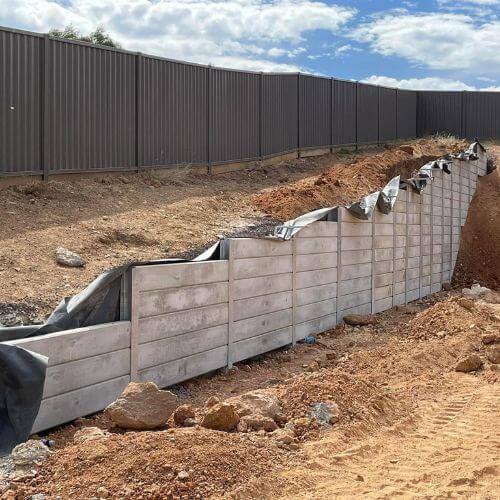
Wood look concrete sleepers are reinforced concrete sleepers finished with a cast timber-grain texture, giving you a natural timber appearance without rot, termites or re-staining. They're part of our woodgrain concrete sleepers range, cost roughly the same as our other concrete finishes, and pair with standard galvanised steel posts.
If you like the warmth of timber but don't want the upkeep, this guide breaks down exactly how the wood-look finish is made, what colour and texture options you get, where it suits best, and what you need to build a complete wall system around it — so you can decide with your eyes open before you order, whether you're building a single garden bed border or a full boundary wall.

Why Wood-Look Concrete
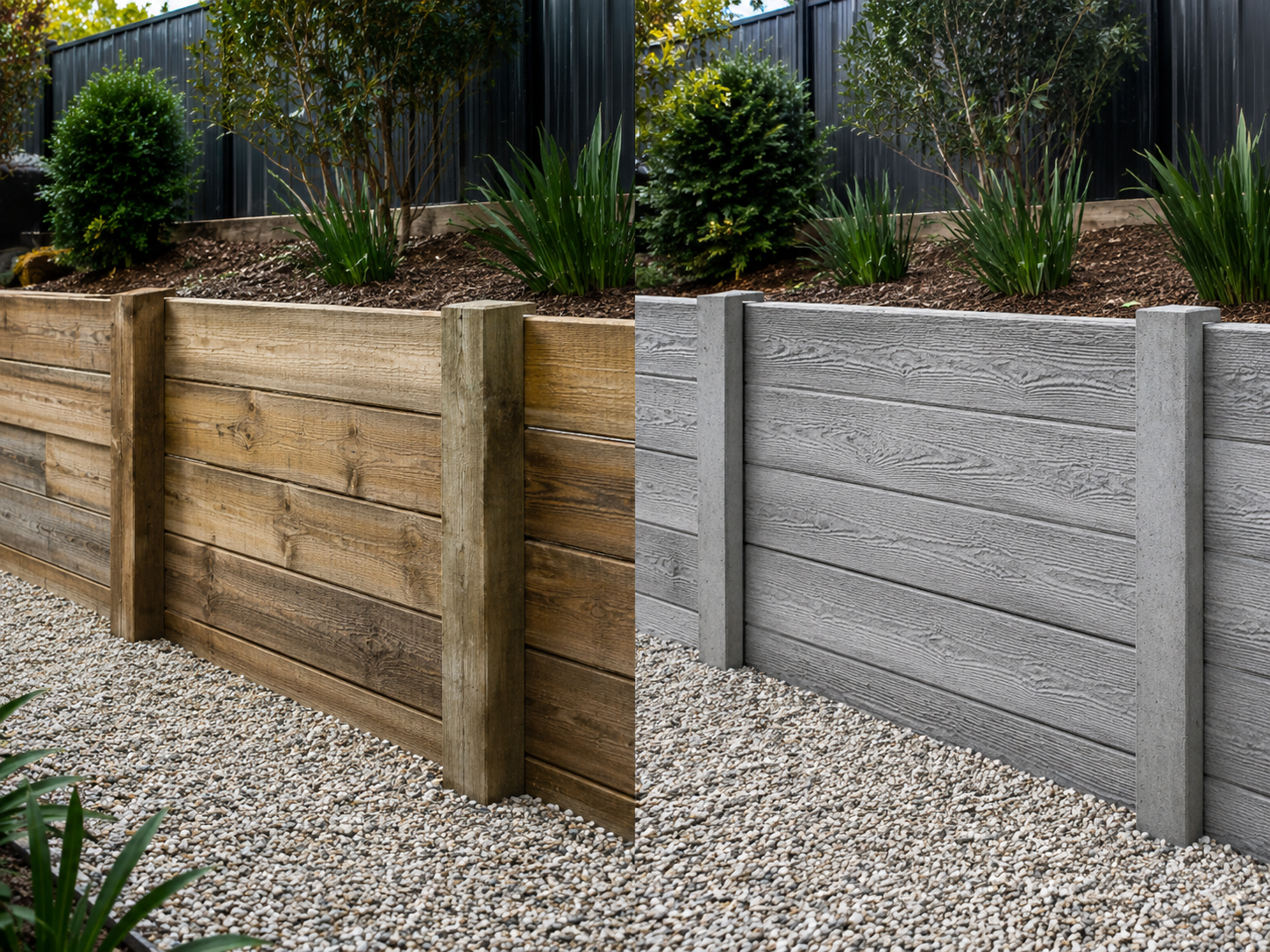
Homeowners and landscapers reach for wood-look concrete sleepers for one main reason: they want the timber aesthetic on a wall that's genuinely low-maintenance. Real timber sleepers deliver the look for a while, but they weather, grey and eventually need replacing. Wood-look concrete keeps the appearance without that clock running.
- The timber look, without periodic oiling, staining or sealing
- No rot, termites or splitting in ground contact
- Consistent appearance year after year — it doesn't grey like weathered pine
- Same structural performance as our other concrete sleeper finishes
The Decision Most Buyers are Actually Making
In practice, very few people choosing between wood-look concrete and real timber are indifferent to appearance — they've usually already decided they want a timber look. The real decision is whether to accept timber's maintenance and replacement cycle to get that look, or whether to get the same visual result from a material that doesn't carry those costs. Framed that way, wood-look concrete isn't really competing with smooth or charcoal concrete finishes at all — it's competing directly with real timber, on timber's own aesthetic terms. That's also why buyers researching this finish tend to compare it against timber pricing and lifespan rather than against other concrete finishes, and why a straight comparison against real timber is usually the more useful reference point than comparing woodgrain to smooth or charcoal concrete.
Where The Timber Look Still Loses Out to Concrete
It's worth being upfront about where wood-look concrete doesn't fully replicate timber: it won't have the exact tactile surface of real wood grain if you run a hand over it, and very close up, a trained eye can usually tell the difference between a textured concrete face and actual timber fibre. For a retaining wall viewed from normal distances — which is how a wall is experienced day to day — that distinction essentially disappears.
What It Costs Compared to Real Timber
Wood-look concrete sleepers sit above treated pine on upfront price per metre, and roughly in line with our other concrete finishes — smooth and charcoal — since the finish is cosmetic rather than structural. The more useful comparison isn't upfront price at all, though; it's total cost across the life of the wall. A timber wall that needs rebuilding once or twice over 20–30 years carries the labour and disposal cost of each rebuild on top of the original material cost, while a wood-look concrete wall built once carries none of that repeat cost. For homeowners planning to stay on a property long-term, or for landscapers pricing a job where the client has explicitly asked for low ongoing maintenance, that total-cost picture usually favours concrete even though the day-one invoice is higher.
How the Timber Grain is Cast
The wood-look finish comes from the mould, not a coating. A textured mould with a genuine timber-grain pattern is used when the sleeper is poured, so the grain lines, knots and texture are pressed into the concrete face as it cures. Because it's structural, not surface-applied, it doesn't peel, chip or wear off the way a paint effect would.

Why Mould Quality is the Whole Game
Not all wood-look concrete looks equally convincing, and the difference almost always comes down to the mould. A basic mould with a shallow, repeating pattern reads as obviously artificial once a wall is built, because the same grain pattern repeats down the wall at regular intervals — something real timber never does. A higher-quality mould uses irregular grain spacing, varied knot placement, and enough surface depth to catch shadow properly in low-angle light, the same way real timber grain does. This is one of the genuine quality differences between suppliers in this category, and it's worth looking at actual installed walls, not just a single product photo, before deciding a finish looks convincing. Photos in bright, even lighting tend to flatter every finish equally — a wall viewed in person, ideally at different times of day, gives a far more honest sense of how the texture and shadow lines actually read.
Colour: Integral vs Surface-Applied
Colour in wood-look concrete sleepers is achieved one of two ways. Integral colour is mixed through the concrete itself before pouring, so the colour runs through the full thickness of the textured face — if the surface ever wears slightly, the colour underneath matches. Surface-applied colour is a pigment or stain applied to the textured face after casting and then sealed; it can look excellent initially but is more exposed to gradual change if the sealer wears thin over many years. If long-term colour consistency matters to your project, it's a fair question to ask a supplier directly.
Does the Texture Wear Down Over time?
Because the timber-grain texture is structural — pressed into the concrete during casting, not applied as a surface layer — it doesn't wear off the way a stencilled or painted timber effect would. The main thing that changes a textured concrete surface over decades is general weathering common to all outdoor concrete: very minor surface softening of sharp mould edges, and the kind of light surface staining any masonry picks up from dirt, leaf litter or algae in shaded spots. None of that affects the underlying grain pattern, which is cast into the sleeper's mass rather than sitting on top of it.
Finish and Colour Options
Within the wood-look range, tones vary from a natural mid-brown timber shade through to a bleached, coastal weathered-timber look. Choosing between them is largely a matter of what the sleeper needs to sit against.
Matching tone to setting
- Warm brick and traditional homes — a mid-brown, natural timber tone tends to complement warm brick and roof tones rather than contrast against them.
- Modern rendered façades — a lighter, driftwood-style wood-look tone can soften a hard-edged, contemporary exterior without looking mismatched.
- Coastal and native gardens — bleached, weathered wood-look finishes pair naturally with native planting and coastal landscaping themes.
- Existing timber features — if there's already a timber fence, deck or pergola on the property, matching or closely complementing that existing timber tone usually gives the most cohesive result.
Comparing Wood-look to other Finishes
If you're deciding between wood-look and our other finishes — charcoal or smooth — rather than just colours within the wood-look range, our team has already put together a full breakdown in charcoal vs woodgrain vs smooth concrete sleepers. It's worth reading before you commit, since the right finish is usually about the property's overall palette rather than the sleeper viewed in isolation.
Where they Suit Best
Wood-look concrete sleepers work well anywhere you want a natural, warm aesthetic without a maintenance commitment:
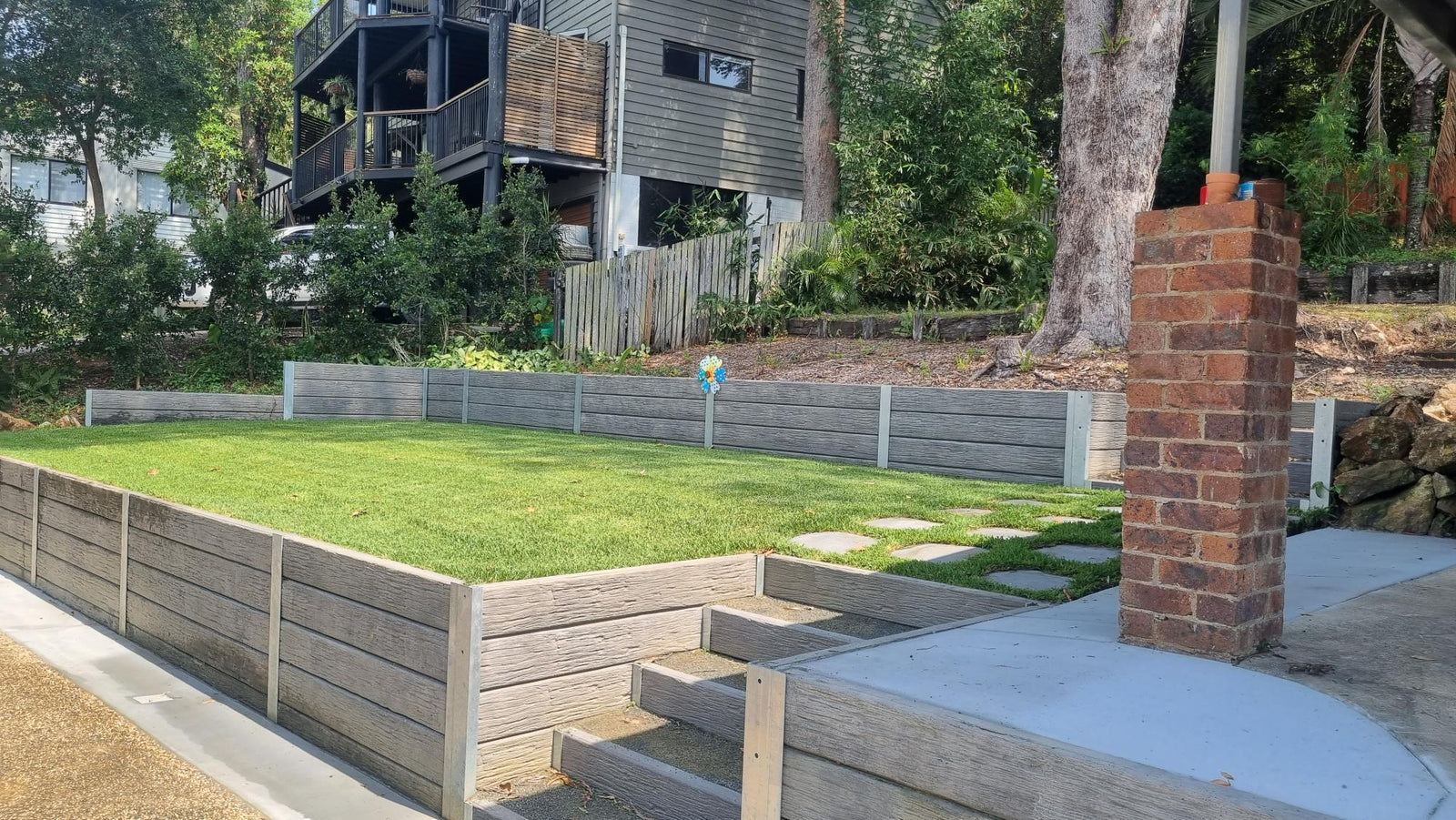
- Garden borders and raised garden beds where a timber look is preferred over grey concrete
- Boundary and driveway walls where you want the street presence of timber but a longer service life
- Coastal and subtropical properties, where real timber weathers faster and salt-air exposure is harder on treated pine
- Renovation projects replacing a failing timber wall on the same footprint
- Rental and investment properties, where a maintenance-free finish reduces ongoing landlord upkeep

Sites where Wood-look Concrete Earns its Keep Fastest
The value of choosing concrete over real timber is most obvious on sites where timber struggles hardest: heavy clay soils that hold moisture against ground-contact timber, coastal properties with salt-laden air, and shaded, damp positions where timber rarely gets a chance to dry out between rain events. On a well-drained, sunny inland block, timber will generally last longer than it would in those harsher conditions — but the wood-look finish still removes the ongoing maintenance either way, which is often the deciding factor for busy homeowners regardless of soil type.
A Few Practical Scenarios
- Sloping blocks with tiered garden beds — wood-look concrete holds its shape and finish across multiple retaining tiers without the visual inconsistency that comes from different timber sleepers weathering at different rates depending on sun and shade exposure.
- Pool surrounds — chlorinated splash-back and constant moisture are hard on treated pine; concrete handles that environment without the same degradation risk.
- Driveway retaining walls — these walls often carry vehicle surcharge loads and get knocked by reversing cars occasionally; concrete's impact resistance and consistent strength grade make it a more forgiving choice here than timber.
- Rural and acreage properties — where a wall might not get regular attention, a maintenance-free finish avoids the wall being forgotten about until timber sleepers are visibly failing.
Common mistake: assuming any concrete sleeper wall can go in without engineering, regardless of finish. Under AS 4678, walls over about 1.0m, on reactive clay, near boundaries or carrying a driveway generally need a higher strength grade and, often, an engineer's sign-off. Confirm requirements with your local council before ordering.
Wall System & Posts
Wood-look sleepers slide into the same galvanised steel post system as every other finish we stock — there's no special post required.
- Standard residential walls typically use 100 Series posts in stable, well-drained ground
- Taller walls or reactive clay usually step up to a heavier post spec
- Posts are hot-dip galvanised for corrosion resistance in Australian conditions
Drainage: The Part that Protects the Whole System
Regardless of how good the sleeper finish looks, drainage is what actually protects a retaining wall over its lifetime. Water pressure building up behind a wall is one of the most common causes of retaining wall failure — timber or concrete, wood-look or plain. A sound drainage approach typically includes free-draining gravel backfill immediately behind the wall, a slotted ag pipe at the base falling to a discharge point, and a geotextile fabric layer to stop fine soil particles migrating into the drainage gravel over time. None of this is optional just because concrete doesn't rot — a wood-look concrete wall with poor drainage can still fail structurally under sustained hydrostatic pressure.
Putting the System Together
A complete wood-look wall system is really four elements working together: correctly specified sleepers, correctly sized and spaced posts, a footing that matches the post embedment requirement for the wall height and soil type, and drainage behind the wall. Skipping or under-speccing any one of the four undermines the other three — there's no point choosing a premium finish and strength grade if the drainage behind it is an afterthought.
Post Spacing in Practice
Post spacing tightens as wall height increases, because taller walls retain more soil and generate greater lateral load per linear metre of wall. A low garden-height wall can often use wider post spacing than a wall approaching the height where engineering sign-off becomes necessary. This is one of the reasons a like-for-like price comparison between two quotes can be misleading if the post spacing differs — a quote with wider post spacing may look cheaper on paper while being under-specified for the actual wall height and soil conditions. Always compare quotes on a matched spec, not just a matched sleeper finish.
For a full look at how the wood-look finish stacks up against real timber on lifespan and lifetime cost, see how woodgrain compares to timber. If you'd like to understand exactly how the timber-look surface is produced, our companion guide covers how concrete sleepers are made to look like wood in more depth, including how realistic the finish is up close.
Frequently Asked Questions
Do wood-look concrete sleepers actually look real, or obviously fake?
From normal viewing distance — the way a retaining wall is actually seen day to day — a good-quality wood-look finish reads convincingly as timber. Up close, or under raking light, a careful eye can usually pick a textured concrete surface from real wood grain, but this is rarely an issue in practice for a wall viewed from a footpath, driveway or garden.
Is "wood-look" the same thing as "woodgrain"?
Yes — these terms describe the same finish category. "Woodgrain" tends to be the more common name for the concrete sleeper finish itself, while "wood-look" describes the visual result buyers are searching for. Both refer to a cast timber-grain texture on a reinforced concrete sleeper.
Can I get a sample before ordering a full wall's worth?
Most suppliers, ourselves included, can arrange a sample or point you to an installed project so you can assess the finish and colour in person before committing to a full order — worth doing if colour matching to an existing house or fence is important to your project.
How do I know which wood-look tone will suit my home?
Look at the dominant existing tones on the property — brick, render, roofing and existing timber or fencing — and choose a wood-look shade that sits within that palette rather than fighting against it. If in doubt, a mid-brown, natural timber tone is the safest starting point, since it tends to complement the widest range of existing colour schemes.
A short checklist before you order
- Confirm your retained height — measured from the base of the wall to the finished ground level being held back, not just the visible sleeper height.
- Check your soil type — reactive clay and poorly drained sites typically need a higher strength grade and closer post spacing than stable, well-drained ground.
- Plan drainage before you plan the finish — ag pipe, gravel backfill and geotextile fabric protect the wall regardless of which sleeper finish you choose.
- Confirm council requirements early — height thresholds and approval requirements vary by council, and it's far easier to check before ordering than after a wall is built.
- Ask about colour method — integral versus surface-applied colour affects how the finish ages over decades, not just how it looks on day one.
- Get quotes on a matched spec — compare strength grade, post spacing and post profile across suppliers, not just the sleeper finish, so you're comparing like with like.
Get a Quote
Ready to see it in your own wall? Browse the woodgrain concrete sleepers range, or go straight to the timber grain concrete sleeper product page for sizes and pricing. Our team can also help you match a finish and strength grade to your specific soil type and wall height before you order — worth doing before you commit to a quantity, since getting the spec right the first time avoids costly changes once a wall is partway built.



Leave a comment (all fields required)