


Quick Answer
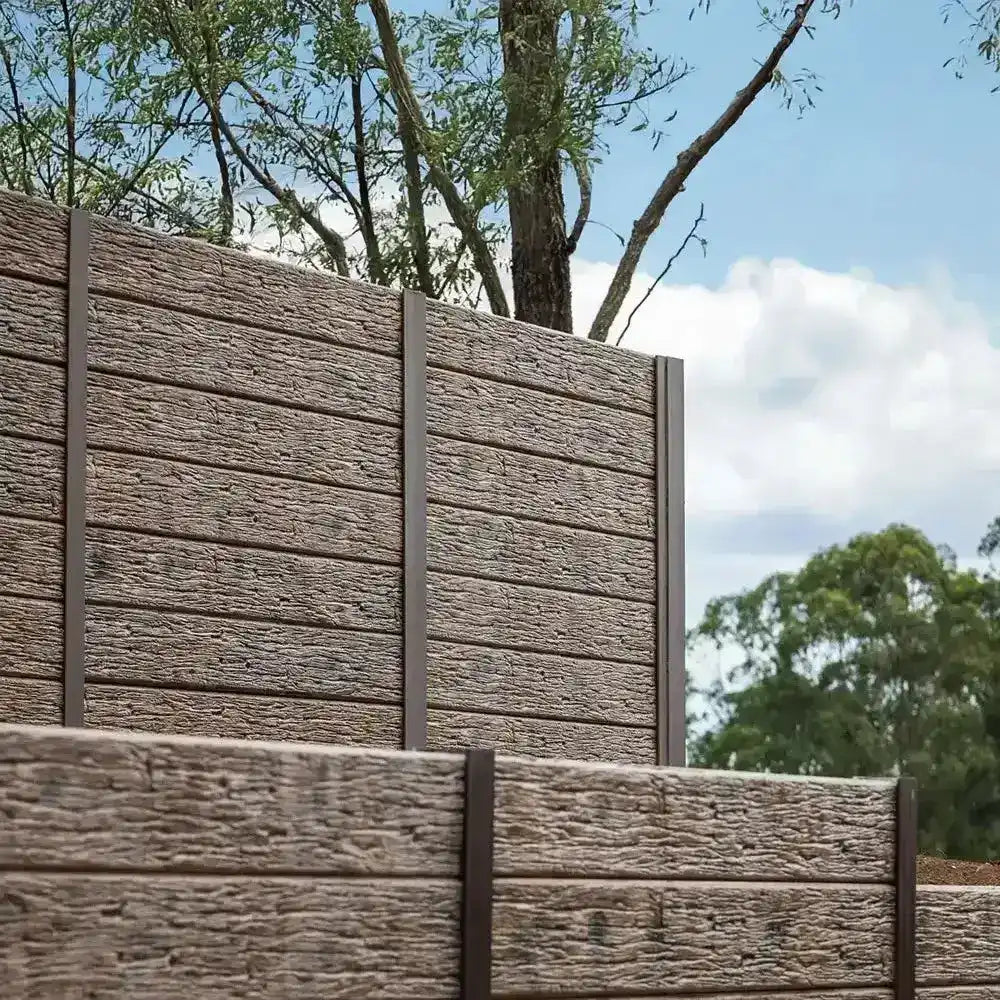
Concrete sleepers are made to look like wood using a textured mould with a genuine timber-grain pattern pressed into the concrete face during casting. The grain, knots and texture become part of the concrete's surface as it cures, not a coating applied afterwards, which is why the finish doesn't peel, wear off or need reapplying. The result is part of our woodgrain concrete sleepers range.
This guide goes behind the scenes on how the timber-look finish is actually produced, how convincing it really is up close and from a distance, what colour options exist, and how it stacks up against real timber for anyone still deciding between the two — useful reading whether you're a homeowner comparing samples or a landscaper explaining the product to a client for the first time.

How the Woodgrain Texture is Manufactured
The process starts with a mould — typically a rubber or polyurethane liner with a timber-grain pattern moulded into its surface, often taken from a real piece of timber to capture authentic, irregular grain detail rather than a generic repeating pattern. Concrete is poured into this textured mould along with steel reinforcement, and as the concrete cures, it takes on the exact texture of the mould's surface.
Why the Mould Source Matters
Higher-quality woodgrain moulds are cast from an actual timber board, capturing genuine grain irregularity, knot placement and surface variation. Lower-quality moulds use a simpler, repeating pattern that's cheaper to produce but reads as artificial once it's repeated down the length of a wall — real timber never lines up its grain in a perfect, repeating sequence, so a repeating pattern is one of the easiest ways to spot a lower-quality woodgrain finish. Manufacturers who invest in a genuine timber-cast mould are effectively paying a one-off tooling cost to produce a more convincing, more varied texture across every sleeper poured from it — a cost that ultimately shows up as a small premium on the finished product, but one that's usually worth paying for a wall that's meant to look genuinely like timber rather than an obvious imitation.
The Pour and Cure Process
Once the mould is prepared and reinforcement is placed, the concrete mix is poured and vibrated to remove air pockets and ensure the mix fully fills the mould's surface detail — a poorly vibrated pour can leave the grain texture looking soft or incomplete. The sleeper is then cured, typically under controlled conditions, before being removed from the mould. Curing time and conditions affect the final strength grade (40, 50 or 60MPa) as much as they affect surface finish, so a rushed cure can compromise structural performance even if the texture looks fine on the surface.
Where Colour Enters the Process
Colour is added either as an integral oxide mixed through the concrete before pouring, or as a surface-applied pigment or stain sealed onto the textured face after casting. Integral colour runs through the full thickness of the textured surface, so minor wear over decades doesn't expose a different colour underneath. Surface-applied colour can achieve excellent initial results but depends on the sealer holding up over time to keep the colour consistent. This is a fair question to ask any supplier directly if long-term appearance matters to your project.
Reinforcement and Strength Grade
The timber-grain texture is entirely cosmetic — it has no bearing on the sleeper's structural performance. Underneath the textured face, a woodgrain sleeper carries the same steel reinforcement and is poured to the same strength grade (commonly 40MPa, 50MPa or 60MPa) as our smooth and charcoal finishes. Strength grade is selected based on the wall's retained height, soil type and post spacing, exactly as it would be for any concrete sleeper — the decision to choose a woodgrain finish shouldn't influence the engineering side of the specification at all.
Quality Control in Manufacturing
Reputable manufacturers test cured sleepers for compressive strength to confirm the batch meets its rated MPa grade, separate from any assessment of the surface finish. A sleeper can look visually perfect and still fail a strength test if the mix design, vibration or curing process wasn't followed correctly — which is why buying from an established supplier with consistent quality control matters more than judging a sleeper purely on how convincing its woodgrain texture looks in a showroom or photo. Ask a supplier about their testing regime and strength certification if you're specifying sleepers for a wall that will need council approval or an engineer's sign-off — this documentation is often required as part of that process.
Batch Consistency Across a Wall
One practical detail worth knowing: sleepers from the same production batch, using the same mould, will have more consistent grain patterns and colour than sleepers ordered separately over time from different batches. If you're building a wall in stages — for example, over successive weekends — ordering all your sleepers upfront in one batch avoids subtle colour or texture mismatches that can appear if a supplier changes mould stock or oxide batch between orders. It's a small logistical detail, but one that makes a noticeable difference to how uniform the finished wall looks once it's fully built and viewed as a whole.
How Realistic is the Finish
This is the question most buyers actually want answered before they commit: does it really look like timber, or does it look like concrete pretending to be timber?

From Normal Viewing Distance
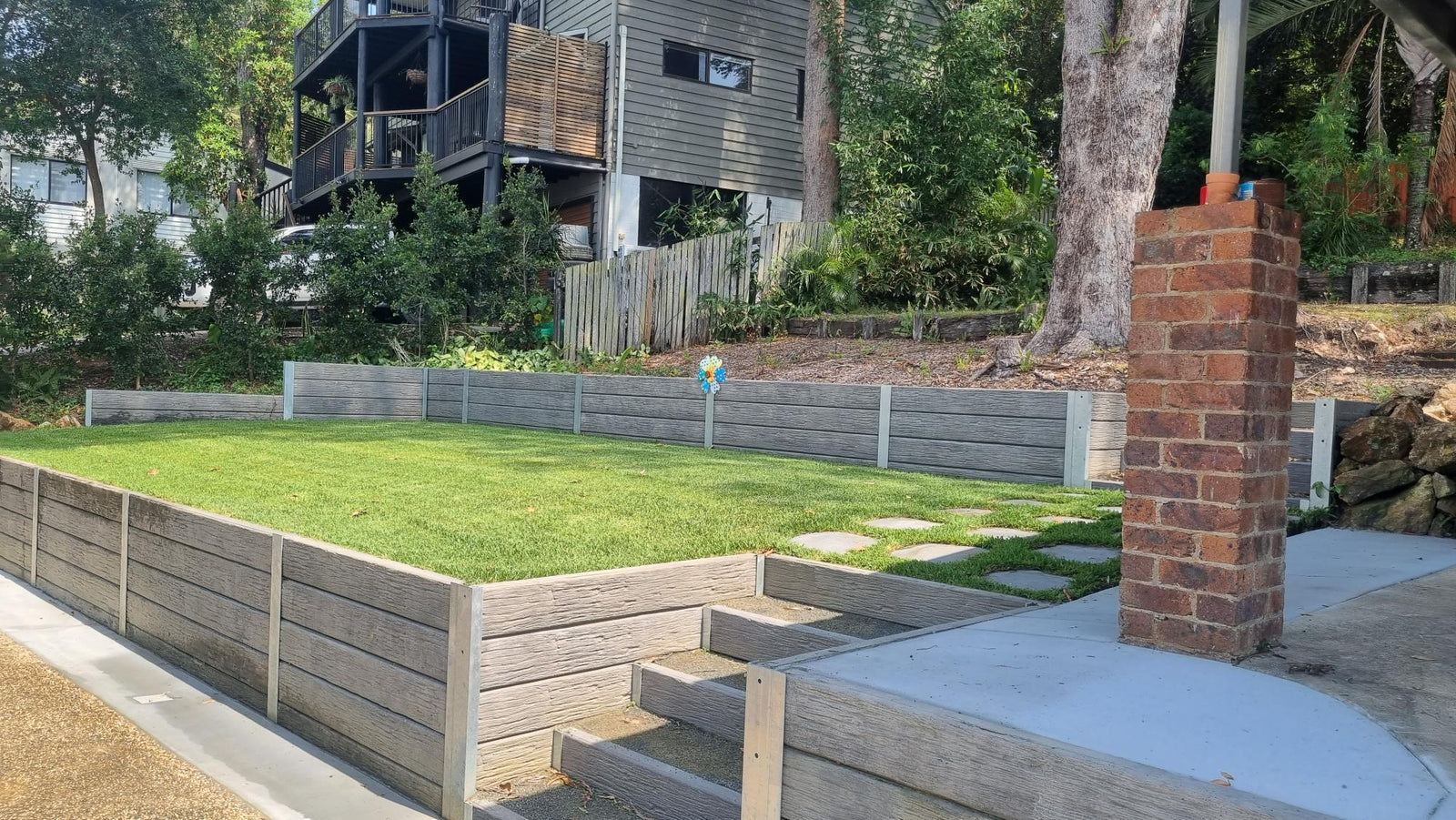
At the distance a retaining wall is normally viewed from — a footpath, a driveway, across a garden — a good-quality woodgrain finish reads convincingly as timber. Grain lines catch shadow the same way real wood grain does, especially in low-angle morning or evening light, and knots and colour variation break up what would otherwise be an obviously uniform surface.
Up Close
Close up, or under direct raking light, a careful eye can usually tell the difference between cast concrete texture and actual timber fibre. The surface is harder and cooler to the touch than real wood, and very fine timber grain detail — the kind you'd notice running a hand along an actual timber sleeper — isn't fully replicated. For a retaining wall, which is rarely inspected at that level of scrutiny, this is a minor trade-off most buyers are comfortable making in exchange for a finish that doesn't rot or need maintenance.
What Actually Gives a Fake Finish Away
The most common tell isn't the texture itself — it's repetition. Real timber grain never repeats in an identical pattern, but a cheap mould used repeatedly down a long wall can create a visible, regular repeat that the eye picks up on subconsciously, even if it can't immediately say why the wall looks slightly artificial. Suppliers using higher-quality, more varied moulds avoid this by staggering or varying the sleeper orientation and pattern along the wall run.
The Role of Lighting and Viewing Angle
Woodgrain texture reads most convincingly in raking light — early morning or late afternoon sun hitting the wall at a low angle, which throws shadow into the grain lines and makes the texture appear deeper and more three-dimensional than flat, overhead midday light does. This is worth knowing if you're assessing a sample or a showroom display: a sleeper viewed under harsh, direct overhead light can look flatter and less convincing than the same sleeper will look installed outdoors under natural changing light throughout the day.
How Weathering Affects Realism Over time
Interestingly, real concrete weathering can sometimes make a woodgrain finish look more convincing over time, not less. Very light surface staining, minor colour variation from sun exposure, and the kind of gentle ageing all outdoor masonry picks up can actually mimic the natural, uneven weathering real timber goes through — without any of the structural degradation timber experiences. A brand-new woodgrain wall photographed on day one and the same wall photographed five years later, having weathered slightly, will often look more like natural timber in the later photo, not less.
What Buyers Say When Comparing in Person
In our experience showing customers wood-look concrete alongside real timber sleepers, the most common reaction isn't "that looks fake" — it's genuine surprise at how close the texture and colour variation gets, followed by questions about maintenance and cost rather than further questions about appearance. That's a reasonable proxy for how convincing the finish is in practice: once appearance stops being the deciding factor, the conversation naturally shifts to the practical differences that actually separate the two materials.
Colour Range and Options
Woodgrain concrete sleepers are typically available in a handful of timber-inspired tones, from a natural mid-brown through to bleached, weathered coastal shades.

- Natural mid-brown — the most common tone, suited to traditional brick and warm-toned homes
- Weathered / driftwood grey-brown — a bleached, coastal-style tone that suits modern renders and native gardens
- Darker aged-timber tones — for a more dramatic, contrast finish against lighter homes or landscaping
For the full breakdown of colour options and which suits which setting, see our woodgrain colours and finishes guide.
Comparing Woodgrain to other Finishes Entirely
If your decision is less about which woodgrain tone to pick and more about whether woodgrain, charcoal or smooth is the right finish altogether, our charcoal vs woodgrain vs smooth concrete sleepers comparison covers that decision directly, rather than duplicating it here.
Why Colour Choice Matters more than it seems
It's tempting to treat colour as a purely aesthetic afterthought once you've decided on the woodgrain finish itself, but the wrong tone can undercut the whole point of choosing a realistic timber look. A woodgrain sleeper in a colour that doesn't relate to anything else on the property — a cool grey-brown against a warm red-brick home, for instance — can end up looking more like "concrete trying to be timber" than a genuinely convincing timber-look wall, simply because the colour breaks the illusion the texture is trying to create. Matching tone to the property's existing palette does more for perceived realism than the texture quality alone.
Common mistake: choosing a finish from a small product photo alone. Lighting, scale and camera angle can make almost any woodgrain finish look convincing in a single image. Where possible, view an installed wall in person, in different lighting, before committing to a full order.
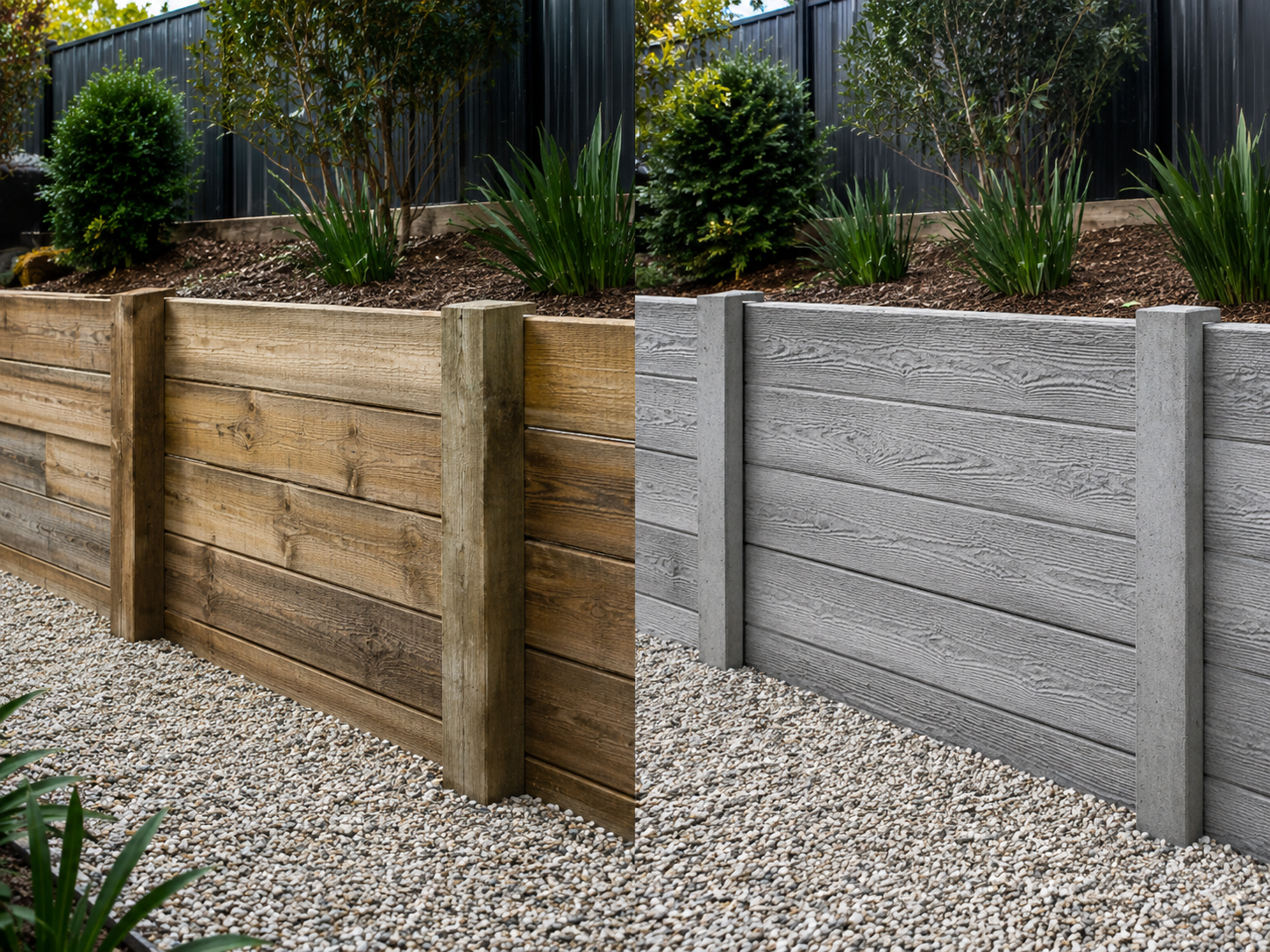
Vs Real Timber, Side by Side
It's worth being direct about how a manufactured wood-look finish actually compares with real timber, rather than treating concrete as a straightforward upgrade in every respect.
Where Concrete Wins
- No rot, termites or ground-contact decay
- No re-staining, oiling or sealing required
- Consistent appearance over decades rather than progressive greying
- Higher resistance to impact and surcharge load, useful near driveways
- Built once, without a replacement cycle every 10 to 15 years
Where Real Timber still has an Edge
- Genuine timber texture and warmth to the touch, which a cast finish approximates rather than replicates exactly
- Typically a lower purchase price per sleeper upfront
- Can be cut, shaped or modified on-site more easily than concrete
- Lighter individual sleeper weight, which can simplify handling on tight-access sites
A Note on Structural Performance, not just looks
It's worth separating the aesthetic comparison from the structural one, since they don't always move together in people's minds. A woodgrain concrete sleeper isn't just a better-looking version of a plain concrete sleeper for people who prefer timber aesthetics — structurally, it performs identically to any other concrete finish at the same strength grade, and it's this structural consistency, combined with the timber-look surface, that makes it a genuinely different proposition to timber rather than simply "concrete dressed up." A timber sleeper, no matter how well-treated, is still subject to the natural variability of wood as a material — grain direction, knots and moisture content all affect an individual sleeper's strength in ways that don't apply to a manufactured, quality-controlled concrete product.
For the full lifespan and cost comparison — not just the visual and tactile differences covered here — see our dedicated woodgrain vs timber sleepers guide.
A Grounded Way to Decide
If the timber look is non-negotiable but you've already been burned by a rotting or termite-damaged timber wall, a well-made woodgrain concrete sleeper is designed to solve that specific problem without asking you to give up the aesthetic. If budget is the primary constraint and you're comfortable with a maintenance and replacement cycle, real timber remains a legitimate, lower-cost option — it's a genuine trade-off, not a case where one material is objectively better in every situation.
Questions Worth Asking Before you Decide
A few honest questions can help settle the decision faster than debating photos or samples alone. How long do you realistically plan to keep the property? A short-term hold might favour timber's lower upfront cost, while a long-term family home tends to favour concrete's lower lifetime cost. How exposed is the site to moisture, shade or reactive clay? Harder conditions shift the balance further toward concrete. And how important is the exact tactile feel of real timber to you personally, versus simply the visual warmth it brings to a garden or boundary? For most retaining wall applications — viewed rather than touched daily — the visual result is what matters, and that's exactly where a quality woodgrain finish is designed to perform.
FAQs
How do manufacturers make concrete look like wood?
By pouring concrete into a mould with a timber-grain texture pressed into its surface, often cast from a real timber board. The grain, knots and texture become structural detail in the finished sleeper rather than a coating applied afterwards.
Do woodgrain concrete sleepers feel like real timber?
Not quite — the surface is harder and cooler to the touch than real wood, and very fine grain texture isn't fully replicated. Visually, from normal distance, the finish is convincing; the tactile difference is more noticeable up close.
Will the woodgrain texture wear away over time?
No. Because the texture is cast into the concrete's mass rather than applied as a surface coating, it doesn't wear off, peel or chip the way a painted or stencilled finish would.
Why do some woodgrain concrete sleepers look more convincing than others?
Mould quality is the main factor. Moulds cast from real timber with irregular grain and knot placement look far more convincing than cheaper, repeating-pattern moulds, especially once several sleepers are installed side by side along a wall.
Does the woodgrain finish affect how strong the sleeper is?
No. The texture is purely cosmetic and has no bearing on structural performance. Strength grade (40, 50 or 60MPa) and reinforcement are selected the same way for a woodgrain sleeper as for a smooth or charcoal finish, based on wall height, soil type and post spacing.
Can I see a woodgrain finish in person before ordering a full wall?
Yes — most suppliers, ourselves included, can arrange a sample or direct you to an installed project so you can judge colour and texture realism in natural light before committing to a full order.




Leave a comment (all fields required)