

Quick Answer
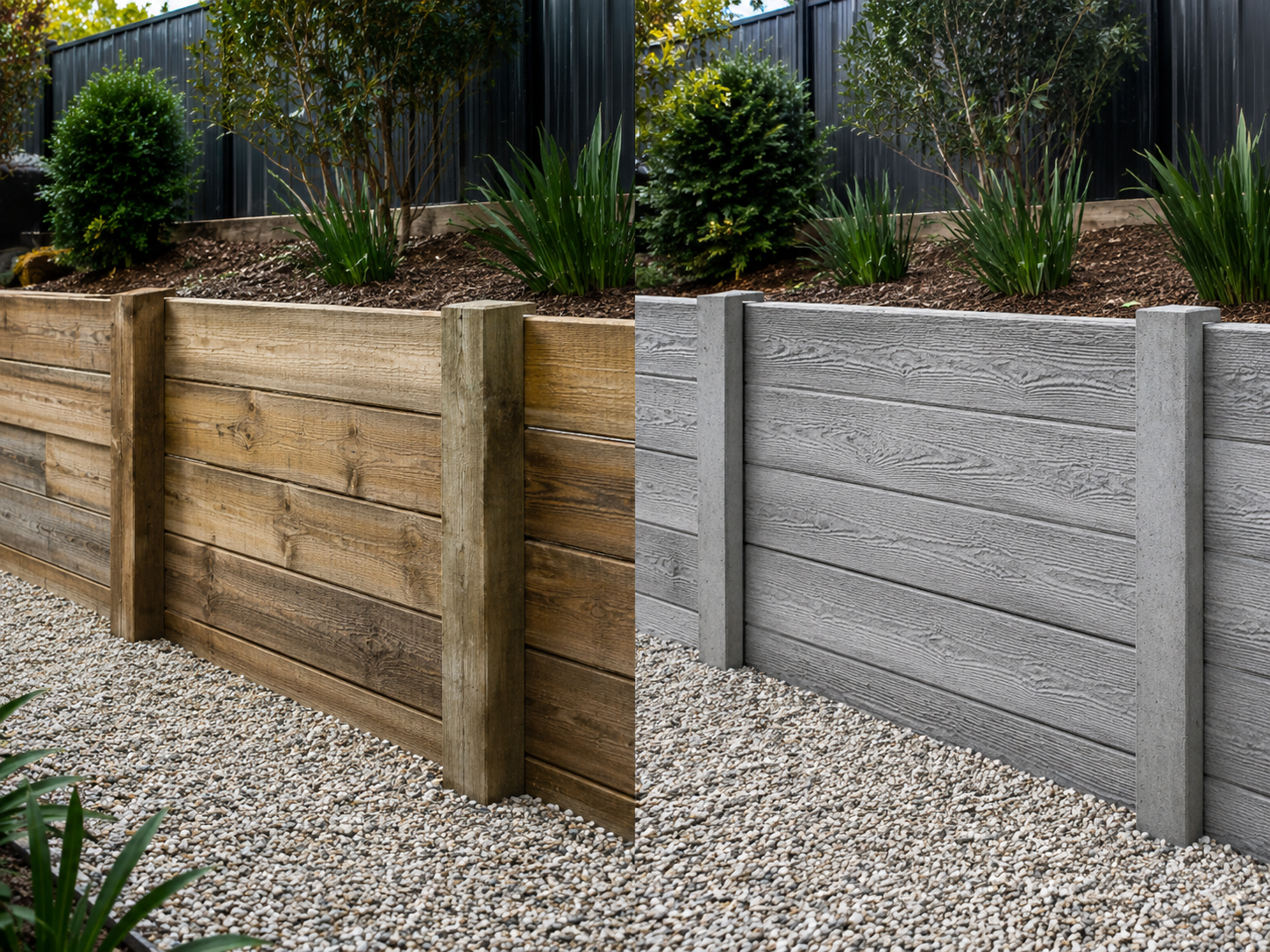
Wood grain concrete sleepers are steel-reinforced concrete sleepers cast with a realistic timber-grain surface. They give you the look of a timber retaining wall without the rot, termites or re-staining — and, built to AS 4678 Earth-retaining structures principles, they're designed to outlast a treated pine wall several times over. They cost more than timber upfront and about the same as our other concrete finishes, and they slot into the same galvanised steel posts as the rest of our range.
This guide is for anyone weighing up a timber-look retaining wall — homeowners replacing a tired timber wall, landscapers quoting a job, or builders specifying materials for a client who wants the timber aesthetic without the maintenance. We'll cover what woodgrain concrete actually is, how it's made, the finish and size options, how it pairs with posts, drainage and engineering basics, and how the cost stacks up against real timber over the life of a wall.

What are Woodgrain Concrete Sleepers?
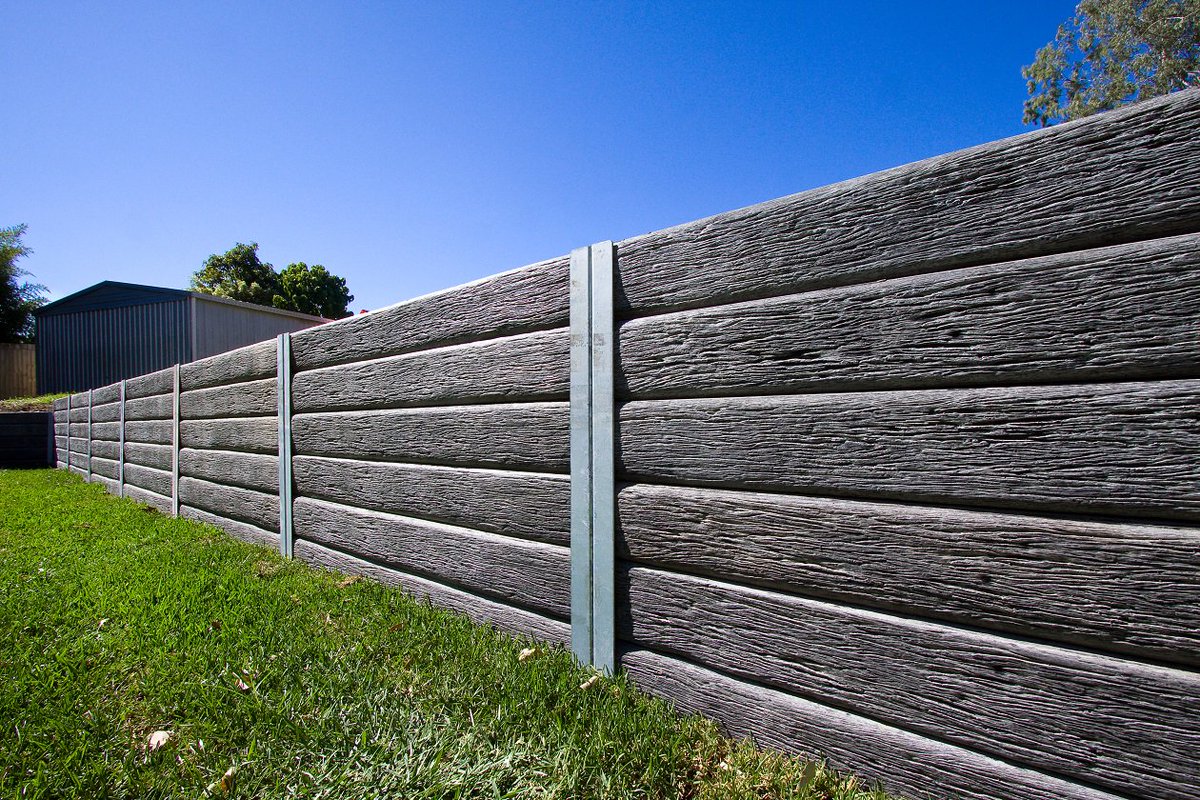
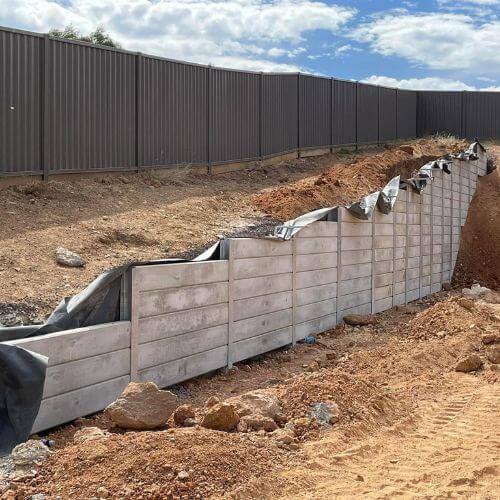
Woodgrain concrete sleepers start life as standard reinforced concrete sleepers. The difference is the mould: it's cast with a timber-grain texture pressed into the face, so the finished sleeper reads as natural timber from normal viewing distance — grain lines, knots and all — while the core is structurally identical to a smooth-finish concrete sleeper.
- Same steel-reinforced concrete core as our smooth and charcoal finishes
- Textured face only — backs and sides stay smooth for a clean stack
- Available in standard strength grades, so structural selection works the same way it does for any concrete sleeper
- Slots into the same galvanised steel post system as every other finish we stock
How it Differs from a Plain Concrete Sleeper
Structurally, nothing changes. The reinforcement, the concrete mix, and the load capacity for a given strength grade are the same whether the face is smooth, charcoal or woodgrain. What changes is purely cosmetic: the texture pressed into the front face during casting. That's an important point for anyone comparing quotes — you're not paying for a weaker or stronger product with a woodgrain finish, you're paying for the mould and finishing process used to create the timber-look surface.
Why the Woodgrain Trend has Grown
Timber has always been a popular retaining wall material in Australia because it looks warm and natural against gardens, brick and render. The problem has always been longevity — treated pine breaks down in ground contact, especially in reactive clay or high-moisture soils. Woodgrain concrete emerged as a direct response: give buyers the timber look they want, on a material that behaves like concrete underneath. It's now one of the fastest-growing finish categories in the concrete sleeper market for exactly that reason.
How Manufacturers Get the Detail Right
Getting a convincing woodgrain finish comes down to the quality of the mould and the pour. A shallow or repetitive mould pattern reads as obviously artificial once you're standing in front of the wall — real timber grain has irregular knots, colour variation and grain-line spacing, and a good woodgrain mould replicates that irregularity rather than stamping the same pattern down the wall in an obvious repeat. The concrete mix itself also matters: a finer aggregate mix picks up more surface detail from the mould than a coarse mix, which is part of why finish quality varies noticeably between manufacturers.
Colour is typically achieved either through an integral oxide mixed through the concrete, or a surface-applied pigment sealed into the textured face. Integral colour tends to hold up better over decades, since any minor surface wear doesn't expose a different colour underneath — worth asking your supplier which method they use if long-term colour consistency matters to you.
The Timber Look Without The Maintenance
Real timber sleepers need ongoing attention — periodic oiling or staining, checking for rot at ground contact, and eventual replacement, usually inside 10 to 15 years in Australian conditions, sometimes sooner in wet or reactive clay soils. Woodgrain concrete is built to skip all of that.
- No rot. Concrete doesn't break down in wet clay or coastal soils the way treated pine can.
- No termites. There's no timber in the sleeper for pests to target.
- No re-staining. The grain and colour are cast in, so they don't grey or fade like weathered timber.
- One installation. A correctly built woodgrain concrete wall is designed to still be standing decades from now, rather than needing a rebuild cycle.
A Real-world Example
We had a customer south of Wollongong last year pull out a collapsing timber sleeper garden wall and rebuild on the same footprint in woodgrain concrete. The brief was simple: keep the look the family liked, but stop replacing the wall every decade. The soil on site was a heavy clay that had been holding moisture against the old timber sleepers for years — exactly the kind of ground condition that shortens a treated pine wall's life. Swapping to concrete removed that failure mode entirely, while keeping the visual result the homeowners wanted.
What "Maintenance-Free" Actually Means
It's worth being precise here rather than making a blanket claim. Woodgrain concrete sleepers don't need oiling, staining, sealing or pest treatment. They can still pick up algae or dirt over time in shaded, damp positions, the same as any masonry surface — a hose-down or occasional wash is the only upkeep most owners ever do. That's a different category of maintenance to what a timber wall needs, where the timber itself is actively degrading and the wall's structural life depends on ongoing care.
For the full side-by-side on lifespan, cost and maintenance, see our woodgrain concrete vs timber sleepers guide.
Available Finishes & Colours
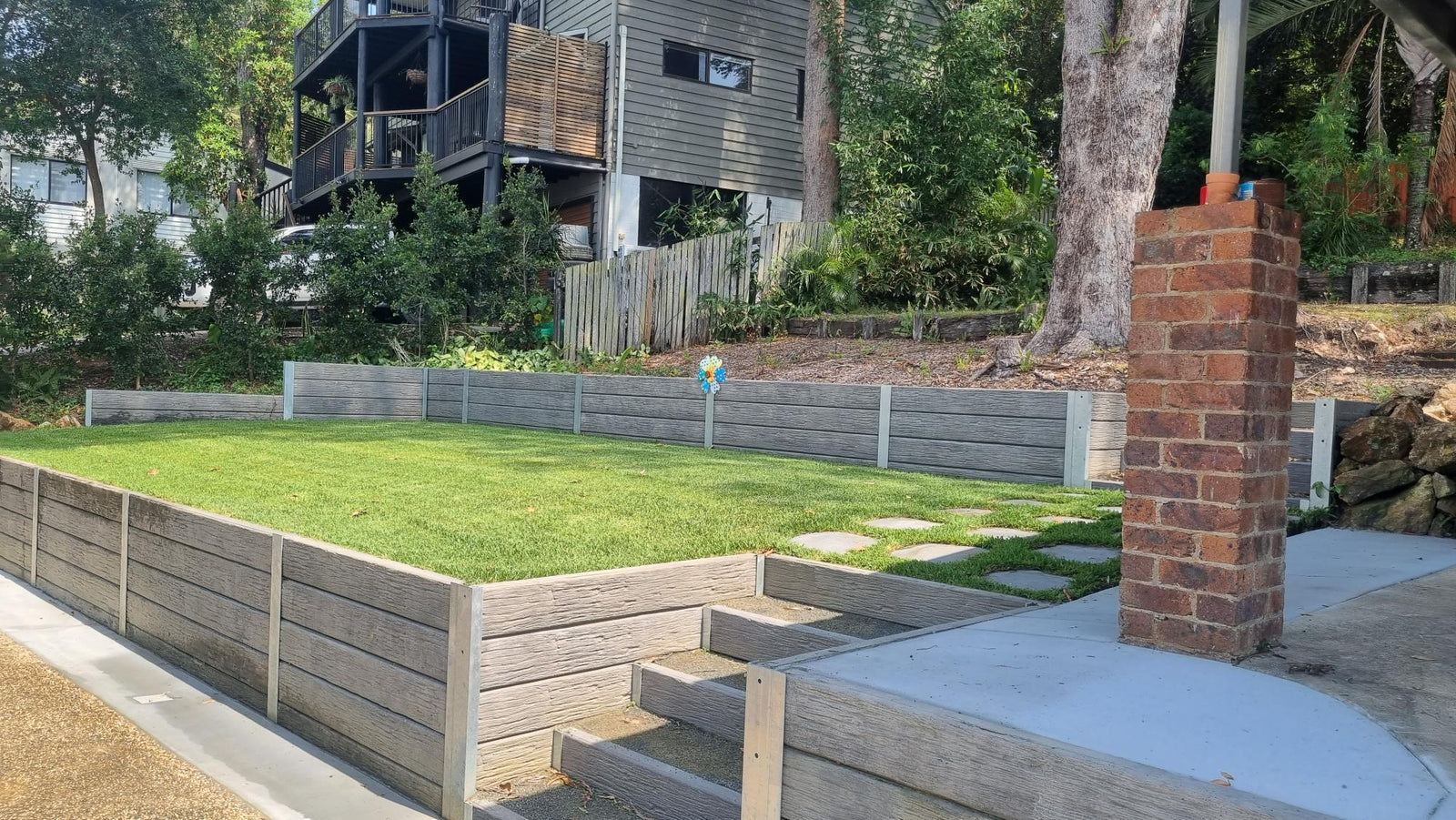
Woodgrain is one of three surface finishes we stock on concrete sleepers, alongside charcoal concrete sleepers and a smooth finish. Within the woodgrain range, tones run from a natural mid-brown timber shade through to a bleached, sun-weathered coastal look, so there's usually a tone that sits well against brick, render or an established garden.

Matching The Finish To Your Project
- Traditional brick homes — a mid-brown woodgrain tone tends to sit naturally against warm brick tones.
- Modern rendered homes — a lighter, bleached woodgrain finish can soften an otherwise hard-edged façade.
- Coastal and subtropical gardens — weathered, driftwood-style woodgrain tones are a popular pairing with native and coastal planting.
- Mixed-material fences and boundaries — woodgrain sleepers under an existing timber or steel fence line tend to read as a cohesive, intentional pairing rather than a mismatch.
Choosing Between Finishes, Not Just Colours
If you're deciding between finishes rather than just colours within woodgrain, our team has already put together a side-by-side comparison of charcoal vs woodgrain vs smooth concrete sleepers — worth a look before you commit to a finish, since the right choice often comes down to the overall palette of the property rather than the sleeper in isolation.
Sizes and Strengths (40/50/60MPa)
Woodgrain sleepers come in the same standard dimensions as our other finishes, so sizing a wall works the same way regardless of which surface you choose.

- 200mm high is standard across the woodgrain range, in 80mm and 100mm thicknesses
- Lengths typically from 1800mm to 2400mm, depending on the specific woodgrain design
- 40MPa suits most standard residential walls in stable, well-drained ground
- 50MPa (and 60MPa on some finishes) steps up for taller walls, reactive clay, or surcharge loads
Reading a Wall Height Correctly
Wall height for sizing purposes is measured as the retained height — the vertical distance from the bottom of the wall to the finished ground level being held back, not the total visible height of the sleepers above ground. A wall that looks 900mm tall from the low side can be retaining considerably more soil than that if the ground steps down further on the low side, or if there's a slope continuing above the top of the wall. Getting this measurement right is the difference between correctly specifying 40MPa and under-specifying a wall that needs 50MPa.
Why Strength Grade Matters More Than It Looks
Compressive strength (MPa) affects how much lateral soil pressure a sleeper can safely resist over its design life, not just its resistance to cracking during handling. Under-specifying strength grade for the soil type and wall height is one of the more common — and more expensive — mistakes on a retaining wall project, because it's a mistake that only becomes visible once the wall is already loaded with backfill.
Common Mistake: picking a sleeper thickness on looks alone. Thickness and strength grade should follow your wall height, soil type and post spacing — not the other way around. Under AS 4678, walls over about 1.0m, or those on reactive clay, near boundaries, or carrying a driveway, usually need a higher grade and, often, an engineer's sign-off. Confirm with your local council before you order.
Steel Post Pairing
Woodgrain sleepers slide into the same galvanised steel posts as every other finish we stock — there's no special post required for the woodgrain surface, since the sleeper profile is unchanged.
- 100 Series posts suit most standard-height residential walls in stable ground
- 150 Series posts step up for taller walls or higher soil loads
- All posts are hot-dip galvanised for corrosion resistance in Australian soils

Post Spacing and Embedment
Post spacing and embedment depth are governed by wall height, soil type and post size — not by the sleeper's finish. As a general principle, posts need to be embedded deep enough into a concrete footing to resist the overturning force of the retained soil, and spacing narrows as wall height increases or soil conditions get more demanding. This is genuinely an engineering calculation once you're above modest garden-wall heights, so treat any spacing figure you see online as a starting point for discussion with a supplier or engineer, not a substitute for a proper design check on your specific site.
C-Channel vs H-Beam
Two main post profiles are used across the industry: C-channel (PFC) posts, which suit standard residential walls in stable ground, and H-beam (UC) posts, which offer greater section strength for taller walls or more demanding soil conditions. Woodgrain sleepers work with either profile — the choice comes down to your wall's engineering requirements, not the finish you've selected.
Drainage Still Matters, Regardless of Finish
It's easy to focus entirely on sleeper finish and posts and forget the part of the system that actually protects the wall: drainage. Water pressure building up behind a retaining wall is one of the most common causes of wall failure, and that's true whether the sleepers are timber, smooth concrete or woodgrain concrete — the finish has no bearing on how water behaves in the backfill. A typical drainage approach includes free-draining gravel backfill, a slotted ag pipe at the base of the wall falling to a discharge point, and a geotextile fabric layer to stop fines migrating into the drainage gravel over time. Skipping drainage to save cost on a woodgrain wall undermines the whole point of choosing a long-life material in the first place — the sleepers might not rot, but a wall that's holding back saturated soil under hydrostatic pressure is a structural problem no finish can fix.
Cost vs Timber
Woodgrain concrete sleepers cost more than treated pine per metre upfront. That gap narrows — and usually reverses — once you factor in timber's replacement cycle.
- Timber: lower purchase price, but typically replaced every 10–15 years in Australian conditions, sometimes sooner in wet or coastal environments
- Woodgrain concrete: higher purchase price, built once, no ongoing replacement cost
Thinking in Total Cost, Not Just Sticker Price
A useful way to compare the two materials is to think in terms of cost per year of service, not just cost per sleeper. A timber wall replaced once or twice over 30 years carries the cost of the original build, plus the cost of demolition, disposal and reinstallation each time — labour costs that often exceed the material cost of the replacement sleepers themselves. A woodgrain concrete wall built once carries a higher day-one cost but no repeat of any of those costs across the same period.
Where the Numbers Actually Matter
The size of that gap depends heavily on soil type, drainage, and how exposed the wall is to moisture — the same factors that determine how quickly a timber wall fails in the first place. A wall in well-drained sandy soil with good fall away from the structure will treat timber more kindly than a wall backfilled against reactive clay with poor drainage. Coastal properties add another variable: salt-laden air and higher humidity tend to accelerate timber weathering compared with drier inland sites, which is worth factoring in if you're comparing the two materials for a beachside project. If you want exact per-sleeper and per-metre figures, plus a worked wall cost example, see our woodgrain concrete vs timber sleepers comparison.
Ready to price it up? Browse the full woodgrain concrete sleepers range, or go straight to shop woodgrain concrete sleepers to see sizes and pricing.
FAQs
Do woodgrain concrete sleepers really look like timber?
Yes. The grain, knots and texture are pressed into the concrete during casting, so from normal viewing distance the finish reads as natural timber. Up close, it's a textured concrete surface rather than actual wood grain.
How long do woodgrain concrete sleepers last?
Built and drained correctly, a concrete sleeper wall is designed for a long service life — well beyond the 10–15 years typical of a treated pine wall in Australian soils. Concrete doesn't rot, warp or attract termites the way timber can.
Do I need special posts for woodgrain sleepers?
No. Woodgrain sleepers use the same steel post sizes as our smooth and charcoal finishes, so post selection comes down to wall height and load, not the surface finish.
What size woodgrain sleepers do I need?
It depends on wall height, soil type and post spacing. As a starting point, 40MPa in 80mm thickness suits most standard residential walls; taller walls or reactive clay usually call for a heavier-duty spec. Confirm with an engineer for anything over about 1.0m.
Will woodgrain sleepers crack or fade over time?
Correctly specified and installed sleepers are designed to hold their strength and appearance over decades. As with any concrete product, very minor surface weathering can occur in the first year or two as the concrete fully cures, but the timber-grain texture itself is cast in and doesn't fade or peel.
Can I mix woodgrain sleepers with another finish in the same wall?
It's technically possible since all our finishes share the same dimensions and post system, but mixing finishes in one continuous wall face is unusual and generally isn't recommended unless you're deliberately creating a feature panel or contrast section. Most projects get a cleaner result sticking to one finish for the full wall.
Do woodgrain sleepers cost more to install than plain concrete?
Installation labour is essentially the same regardless of finish, since the sleeper dimensions, weight and post system are identical. Any price difference between finishes comes down to the sleeper itself, not the install process.



Leave a comment (all fields required)