
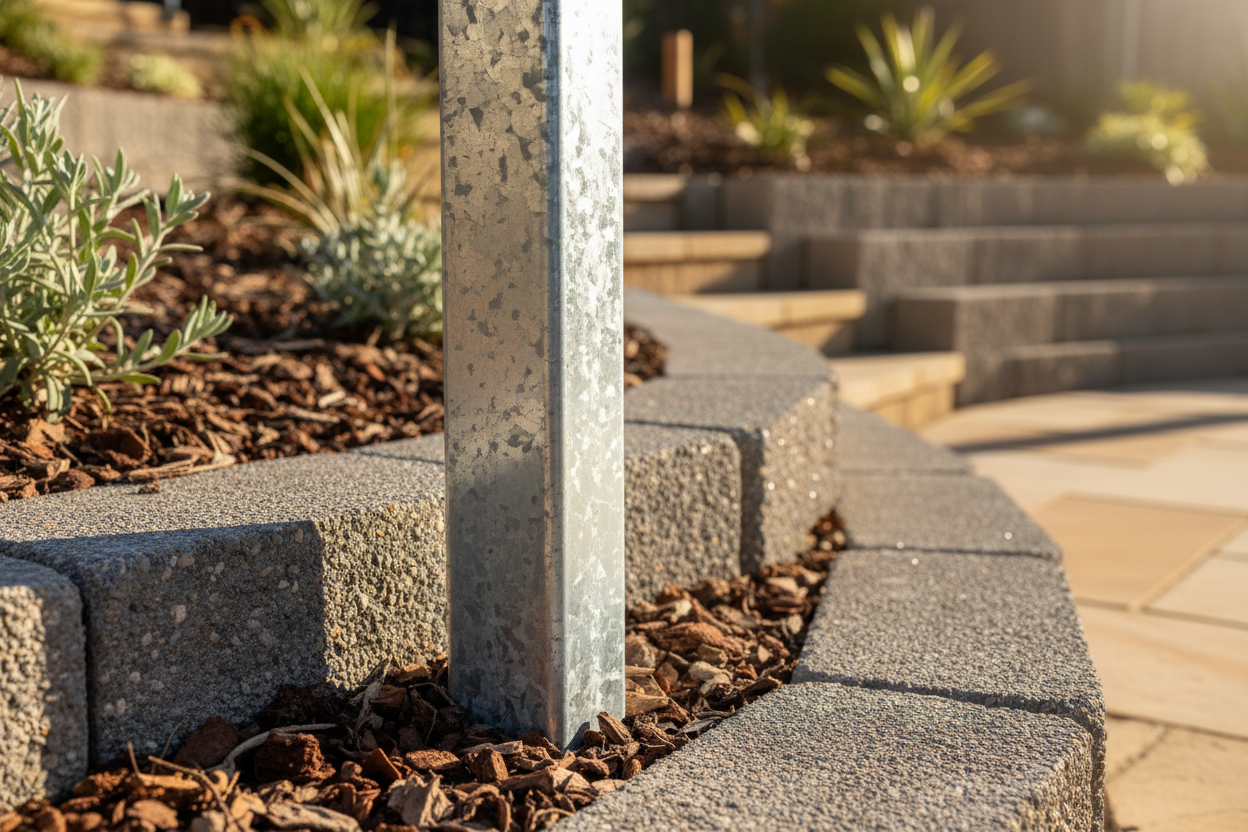

Steel retaining wall posts installed in Australia are almost universally hot-dip galvanised. This guide explains what hot-dip galvanising is, why it is used for retaining wall posts, how long it lasts, and what affects its service life in Australian conditions.
What Is Hot-Dip Galvanising?
Hot-dip galvanising is a process in which steel is coated with a layer of zinc by immersing the steel in a bath of molten zinc at approximately 450°C. The zinc metallurgically bonds to the steel surface, forming a coating that is integral to the steel rather than simply applied on top.
The zinc coating protects the underlying steel from corrosion through two mechanisms:
- Barrier protection: The zinc coating physically separates the steel from contact with moisture, oxygen, and soil.
- Sacrificial (cathodic) protection: Zinc is anodic relative to steel in the galvanic series. Where the coating is damaged or scratched, zinc preferentially corrodes rather than the underlying steel, protecting the exposed steel at the damage site.
This combination of barrier and cathodic protection makes hot-dip galvanising highly effective for steel in buried and exposed-to-soil applications like retaining wall posts.
Why Galvanised Posts for Retaining Walls?
Retaining wall posts operate in a demanding corrosion environment. The lower section of each post is embedded in concrete and soil, typically at a depth of 600mm to over 1000mm depending on the wall height and soil conditions. This embedded section is permanently exposed to moisture and soil chemistry, making it particularly vulnerable to corrosion if the steel is not protected.
Above ground, posts are exposed to rain, humidity, and in coastal locations, salt-laden air. Without corrosion protection, uncoated steel posts in these conditions would have a service life of years, not decades.
Hot-dip galvanising provides a cost-effective, long-lasting corrosion barrier that is well-suited to the conditions that retaining wall posts are subjected to throughout their life in a concrete sleeper retaining wall. They carry the lateral load from the retained soil and must maintain structural integrity for the full design life of the wall.
Galvanising Standards for Retaining Wall Posts
Australian retaining wall steel posts are typically galvanised to AS/NZS 4680 (Hot-dip galvanized (zinc) coatings on fabricated ferrous articles). The standard specifies minimum coating thicknesses based on the steel section thickness:
- Steel ≥ 6mm thick: minimum 85 μm (microns) average coating thickness
- Steel 3–6mm thick: minimum 65 μm average coating thickness
- Steel ≤ 3mm thick: minimum 45 μm average coating thickness
H-beam (UC/UB) and C-channel (PFC) posts used in retaining walls are typically manufactured from steel 6mm or greater in thickness, and are therefore galvanised to a minimum of 85 μm average coating thickness under AS/NZS 4680.
Heavier galvanising coatings (above the AS/NZS 4680 minimum) provide longer service life, particularly in aggressive environments. Posts described as “heavy galvanised” or with a coating thickness specified above the standard minimum (e.g. 100+ μm) will generally provide longer service life than posts galvanised to the minimum standard.
Service Life of Galvanised Retaining Wall Posts
The service life of a galvanised coating depends on the coating thickness and the corrosivity of the environment. ISO 9223 and AS/NZS 4312 classify atmospheric corrosivity into categories from C1 (very low) to CX (extreme), and provide guidance on expected coating consumption rates.
Above-Ground Service Life
In typical Australian inland and suburban environments (C2–C3 corrosivity category), a 85 μm galvanised coating on a structural steel post can be expected to provide 40–70+ years of above-ground service life before first maintenance is required (ISO 14713-1).
In moderate marine environments (C4 corrosivity), service life may be reduced to 25–40 years. In severe marine environments (C5, within approximately 1km of breaking surf), service life may be further reduced and a heavier coating specification or alternative corrosion protection should be considered.
In-Ground and In-Concrete Service Life
The embedded section of a retaining wall post (in concrete and soil) is subjected to different corrosion conditions than the above-ground section. In non-aggressive, well-drained soils, galvanised steel in concrete performs well due to the highly alkaline environment of concrete, which passivates the zinc surface.
In aggressive soils — particularly acidic soils (pH below 6), soils with high chloride content (coastal or industrial areas), or soils with high sulfate content — galvanising performance in the ground is reduced. In these conditions, the coating may be consumed faster than in normal soils, reducing effective service life.
Factors That Affect Service Life
Coastal Proximity
Marine environments significantly accelerate zinc corrosion. The closer a site is to breaking surf or tidal influence, the more aggressive the corrosion environment. Posts within approximately 1km of breaking surf should be specified with a heavier galvanising coating or the use of alternative protection (e.g. epoxy coating over galvanising) should be considered.
Soil Chemistry
Acidic soils (common in some parts of eastern Australia, particularly beneath native vegetation), soils with high organic content, waterlogged soils, and soils contaminated with industrial chemicals all have the potential to accelerate zinc corrosion in the embedded section of the post.
Drainage
Poor drainage that results in the post footing being permanently saturated or subjected to repeated wet-dry cycling will increase the corrosion rate at and below the soil/concrete interface. Correct drainage design and installation is important not only for wall structural performance but also for post service life.
Coating Damage
Damage to the galvanised coating during handling and installation (scratches, impacts) is addressed by the cathodic protection mechanism of zinc — small areas of damaged coating are protected by sacrificial zinc from the surrounding intact coating. Large areas of damage should be repaired using zinc-rich paint before the posts are embedded.
Do Galvanised Posts Require Maintenance?
In residential applications, galvanised retaining wall posts are generally considered maintenance-free for the design life of the wall in typical Australian environments. The above-ground section of the post can be inspected periodically for signs of red rust, which would indicate that the zinc coating has been consumed in that area and the underlying steel is beginning to corrode. Localised zinc-rich paint touch-up can extend service life if applied before significant steel section loss occurs.
In aggressive environments (marine, acidic soils), periodic inspection and touch-up may be warranted to maintain the design life of the concrete sleeper wall system.
Frequently Asked Questions
Can galvanised posts be cut or welded on-site?
Yes, but cutting and welding removes or damages the galvanised coating at the cut or weld location. Cut ends and weld areas should be treated with a zinc-rich paint (minimum 65% zinc dust by dry film weight) before installation. This provides sacrificial zinc protection at the damaged area, similar to the protection provided by the surrounding galvanised coating.
Can galvanised posts be used in concrete?
Yes. Galvanised steel in concrete is a well-established and widely used combination. The alkaline environment of concrete (pH 12–13) passivates the zinc surface, significantly reducing the corrosion rate of the zinc in the embedded section. This makes galvanised posts in concrete footings a highly effective and durable combination for retaining wall applications.
What is the difference between hot-dip galvanising and electro-galvanising?
Hot-dip galvanising produces a much thicker coating (typically 45–150 μm) than electro-galvanising (typically 5–25 μm). For structural steel in outdoor and buried applications, hot-dip galvanising is the appropriate specification. Electro-galvanised steel is suitable for light-gauge indoor applications but is not appropriate for retaining wall posts.
Ready to get started?
Get a free delivered quote for concrete sleepers, steel posts and retaining wall materials — delivered Australia-wide.



Leave a comment (all fields required)