

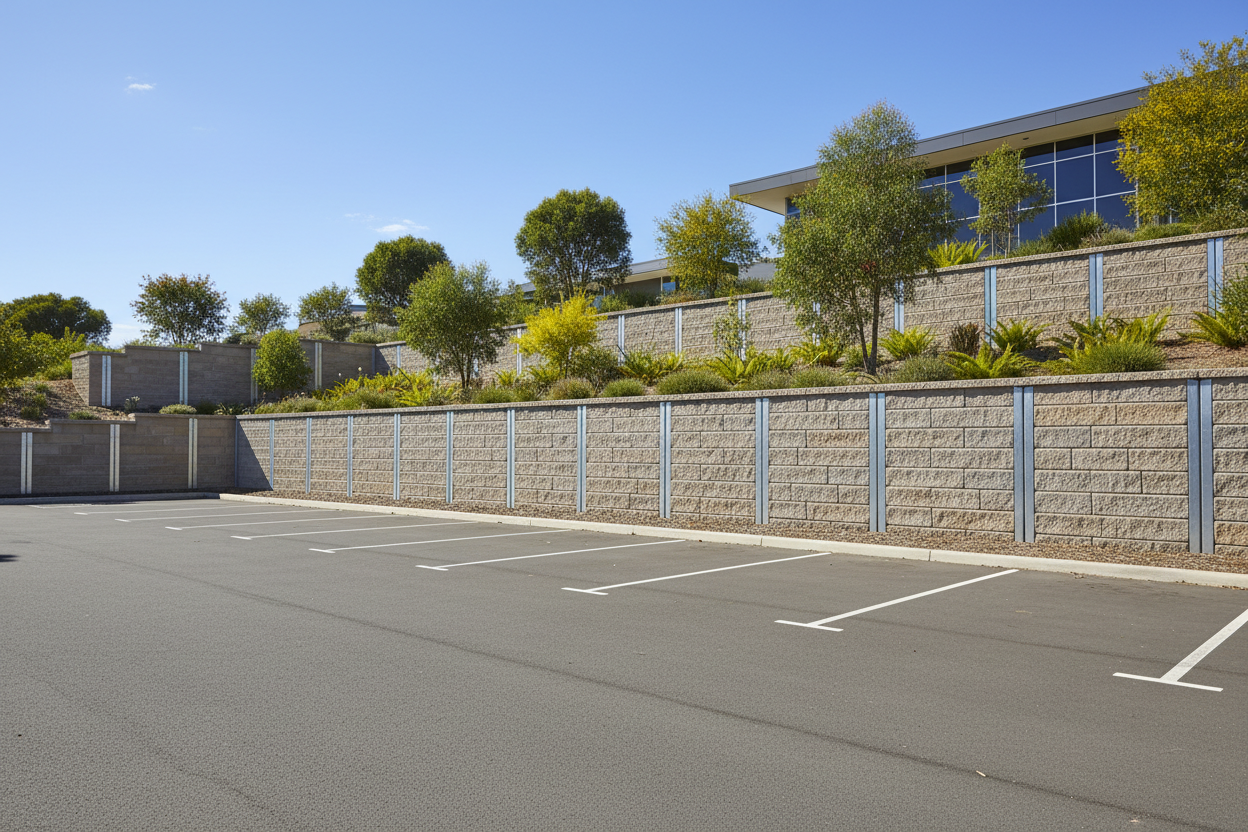

Building a retaining wall on a sloped block is one of the most common and most challenging retaining wall scenarios in Australia. Sloped sites require careful planning — stepped footings, accurate post embedment calculations, tiered wall design for large level changes, and drainage systems that manage water running down the slope.
With many years of hands-on retaining wall construction experience on sloped sites across Australia, I've built walls on every type of slope and soil condition. This guide covers the key design principles, construction techniques, and compliance requirements for retaining walls on sloped blocks.
Key Rule: On a sloped block, the retained height of the wall varies along its length. Always measure the maximum retained height — this is the height that determines your engineering and permit requirements, not the average height.
Understanding Retained Height on a Slope
On a sloped block, the ground level on the retained side of the wall rises as you move along the wall. This means the retained height — the difference between the ground level on the high side and the finished level on the low side — increases along the wall's length.
For permit and engineering purposes, the maximum retained height at any point along the wall is the governing dimension. If the maximum retained height exceeds your council's permit threshold, the entire wall requires a permit — even if most of the wall is below the threshold.
See our guide on when engineering is required and our state-by-state regulations hub.
Stepped Footings — What They Are and Why They're Required
On a sloped site, the base of the wall (and the post footings) must step down with the slope rather than following a continuous level line. This is called a stepped footing.
Stepped footings are required because:
- A continuous level footing on a slope would require excessive excavation at the high end and inadequate embedment at the low end
- Each post must achieve the required embedment depth below the finished ground level at that post's location
- Stepped footings allow the wall to follow the natural slope while maintaining consistent structural performance at each post
How to Calculate Post Embedment on a Slope
Post embedment depth must be calculated at each post position based on the local ground conditions and retained height at that point. The general rule for concrete sleeper retaining walls:
- Walls up to 1.0m: Minimum embedment = 1/3 of total post length, or 600mm minimum, whichever is greater
- Walls over 1.0m: Embedment specified by structural engineer based on soil conditions and retained height
- On slopes: Embedment is measured from the lowest adjacent finished ground level at each post
See our complete post embedment depth guide and our retaining wall footings guide.
Tiered Retaining Walls for Large Level Changes
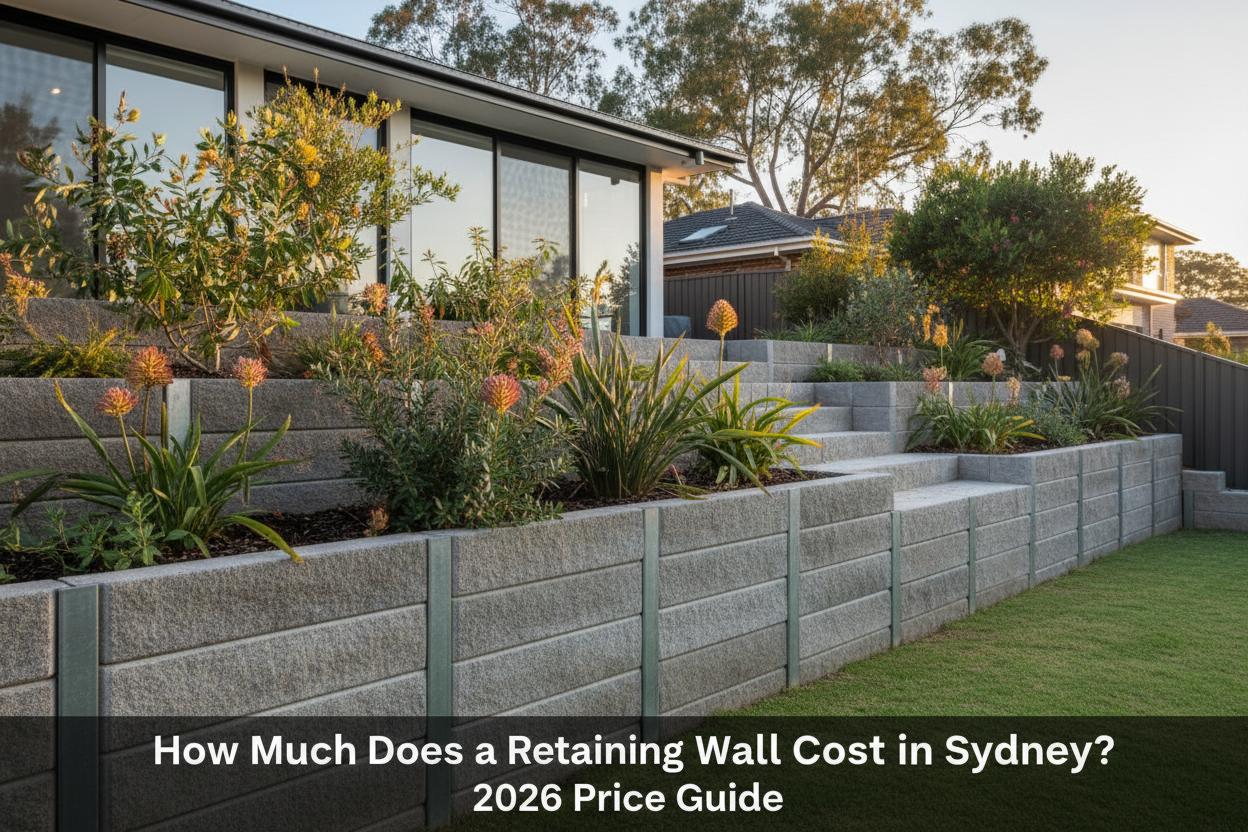
When the total level change on a sloped block exceeds what a single wall can safely retain, a tiered retaining wall system is used. Tiered walls consist of two or more walls at different levels, with a bench or terrace between them.
Tiered Wall Spacing Rules
The minimum horizontal distance between tiered walls is critical for structural stability. The general rule is:
- The horizontal distance between the front face of the lower wall and the front face of the upper wall must be at least equal to the height of the lower wall
- For example: if the lower wall is 1.0m high, the upper wall must be set back at least 1.0m from the lower wall
- In reactive clay soils, a greater setback may be required — specified by a structural engineer
See our complete tiered retaining wall guide.
Engineering Requirements for Tiered Walls
Tiered walls are assessed on their combined retained height for engineering and permit purposes. If the combined height of two tiered walls exceeds the permit threshold, engineering is required for the entire system. See our engineering requirements guide.
Post Selection for Sloped Sites
On sloped sites, the post at the high end of the wall retains more soil and is subject to greater lateral load than posts at the low end. For walls where the retained height varies significantly along the length:
- Use the post specification for the maximum retained height across the entire wall
- Or have an engineer specify different post sizes for different sections of the wall
See our H-beam vs C-channel guide and our complete steel post buyer's guide. Browse our C-channel posts and H-beam posts.
Drainage on Sloped Sites
Drainage is more critical on sloped sites than on flat sites because water running down the slope concentrates behind the wall. Key drainage requirements for sloped sites:
- Ag pipe at the base of the wall: Sized for the catchment area above the wall, not just the wall length. Use 100mm ag pipe where the catchment area is large.
- Drainage gravel: Full-height drainage zone on sloped sites — do not reduce the gravel zone on sloped sites.
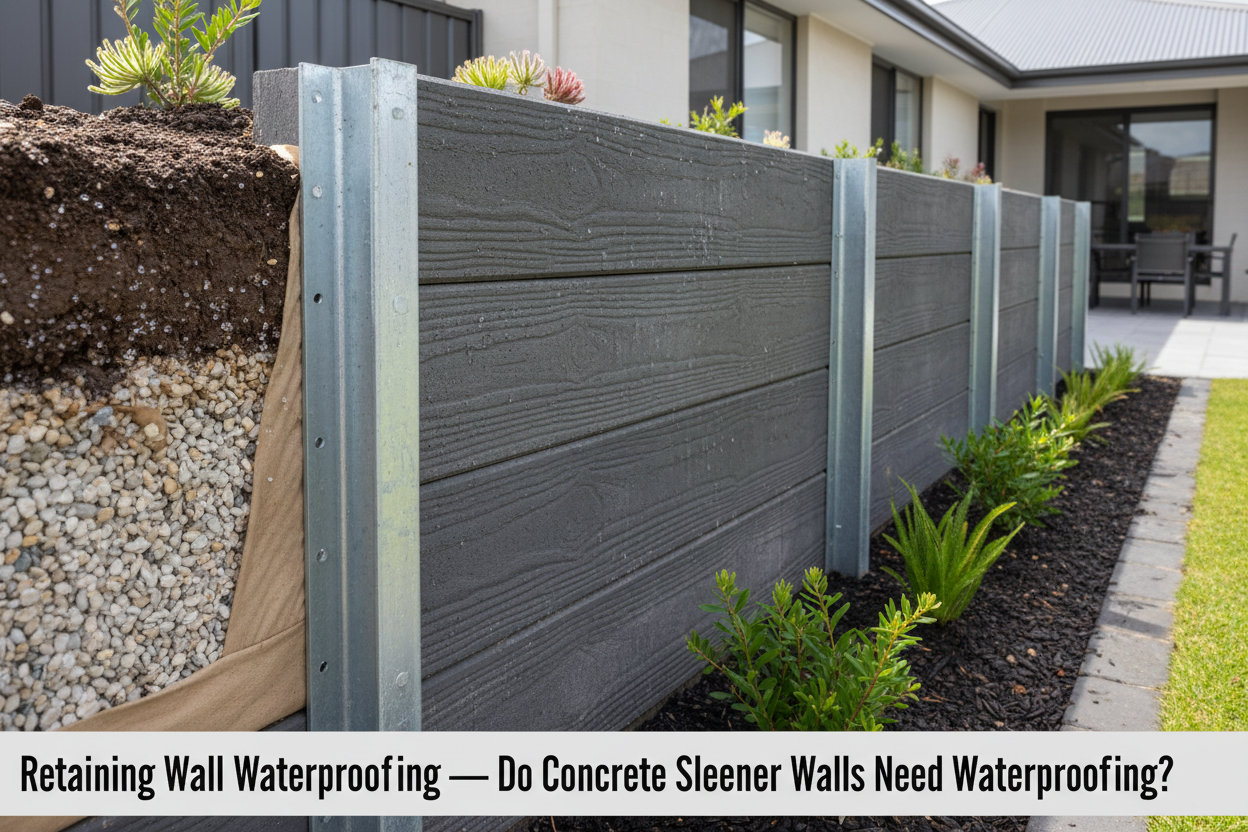
- Geotextile fabric: Essential on sloped sites where soil movement is more likely. See our geotextile fabric guide.
- Outlet at the low end: The ag pipe outlet must be at the lowest point of the wall run and must discharge to a legal point.
- Weep holes: One per 1.8–2.0m of wall length, positioned at the base of the wall.
See our complete drainage installation guide and our ag pipe sizing guide.
Soil Types on Sloped Sites
Sloped sites often have variable soil conditions — rock near the surface at the high end and deeper soil at the low end. Soil type significantly affects post embedment requirements and drainage design. See our soil types guide and our guide on active soil pressure.
Step-by-Step: Building a Retaining Wall on a Slope
- Survey the slope — measure the total level change and determine whether a single wall or tiered system is required
- Check permit requirements — based on maximum retained height. See our council approval guide.
- Engage an engineer if required — for walls over the permit threshold or in reactive soil
- Set out post positions — mark post positions along the wall line, stepping down with the slope
- Drill post holes — each hole must achieve the required embedment depth at that post's location
- Set posts in concrete — check plumb and alignment. Allow 24–48 hours to cure before loading.
- Install sleepers — starting from the lowest point and working up the slope
- Install drainage — ag pipe, gravel, geotextile, and weep holes before backfilling
- Backfill and compact — in 150mm lifts, working away from the wall
Common Mistakes on Sloped Sites
- Measuring average retained height instead of maximum — always use the maximum for permit and engineering purposes
- Insufficient post embedment at the high end of the wall where retained height is greatest
- Undersized drainage — sloped sites have larger catchment areas and require larger ag pipe
- Not accounting for tiered wall spacing requirements — walls too close together can fail together
- Not checking for rock or services before drilling post holes
Frequently Asked Questions
How do I build a retaining wall on a steep slope?
For steep slopes with a large total level change, a tiered retaining wall system is the correct approach. Each tier should not exceed 1.0m–1.2m in height for standard residential walls. The horizontal distance between tiers must be at least equal to the height of the lower wall. See our tiered retaining wall guide.
Do I need a permit for a retaining wall on a slope?
Yes, if the maximum retained height at any point along the wall exceeds your council's permit threshold. On sloped sites, the maximum retained height is often at the high end of the wall. See our council approval guide.
How deep should retaining wall posts be on a slope?
Post embedment must be calculated at each post position based on the local retained height and soil conditions. As a minimum, embedment should be 1/3 of total post length or 600mm, whichever is greater, measured from the lowest adjacent finished ground level. See our post embedment guide.
What is the maximum height for a single retaining wall on a slope?
For standard residential concrete sleeper walls without engineering, the maximum retained height is typically 1.0m (or 600mm in some NSW councils). For walls over this height, engineering is required. There is no absolute maximum for engineered walls — height is limited by the structural design. See our engineering guide.
Order Your Sloped Site Retaining Wall Materials
- Concrete sleepers — all sizes
- C-channel posts — walls up to 1.0m
- H-beam posts — walls over 1.0m or engineered walls
- Drainage kits — sized for sloped site catchment areas
- Geotextile fabric
- Complete retaining wall kits
Use our retaining wall calculator to estimate quantities for sloped sites, or contact our team for advice on your specific slope and soil conditions.
Related guides: Tiered retaining walls · Post embedment depth · Footings guide · Drainage guide · Soil types · Post selection · Engineering guide · Council approval · Calculator



Leave a comment (all fields required)