
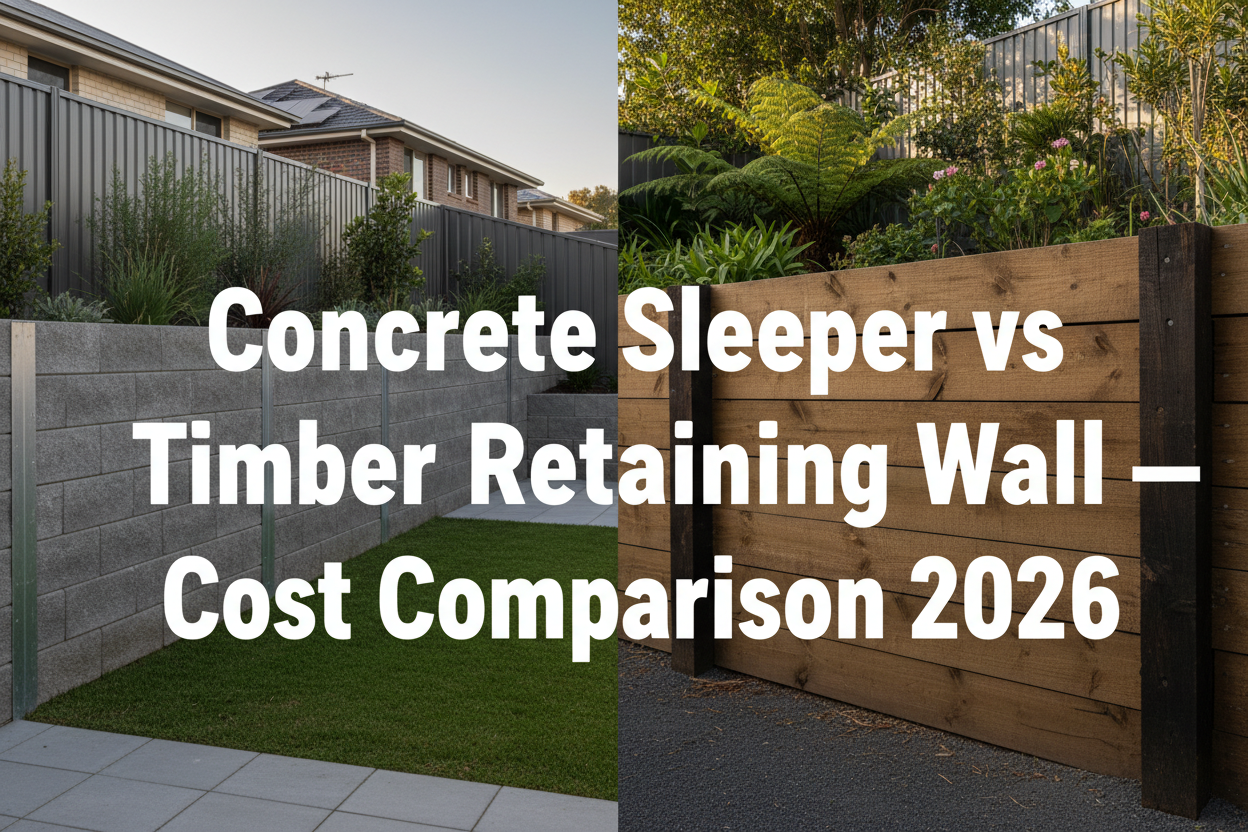

When planning a retaining wall in Australia, the most common material choice comes down to two options: concrete sleepers or treated pine timber. Both work. Both are widely used. But they are not equal in cost, lifespan, or long-term value.
With over 40 years of hands-on retaining wall construction experience, I've built walls with both materials across every Australian state. This guide gives you a straight comparison so you can make the right choice for your project and budget.
Bottom Line: Concrete sleepers cost 20–40% more upfront but last 3–4 times longer than timber. Over the life of the wall, concrete is almost always the cheaper option — and the better-looking one.
Cost Comparison — Concrete Sleeper vs Timber 2026
| Item | Concrete Sleepers | Treated Pine Timber |
|---|---|---|
| Material cost (per m, supply only) | $220–$380 | $150–$260 |
| Installed cost (per m) | $400–$650 | $280–$450 |
| Expected lifespan | 50+ years | 15–25 years |
| Maintenance required | None | Resealing every 3–5 years |
| Replacement cost (per m) | Nil (within lifespan) | $280–$450 (after 15–25 years) |
| Total 50-year cost (per m) | $400–$650 | $560–$1,350 |
| Council permit requirements | Same as timber | Same as concrete |
| Engineering requirements | Same as timber | Same as concrete |
Prices are indicative for Australia 2026. See our national cost guide and Sydney cost guide for detailed pricing.
Concrete Sleeper Retaining Walls — Pros and Cons
Pros
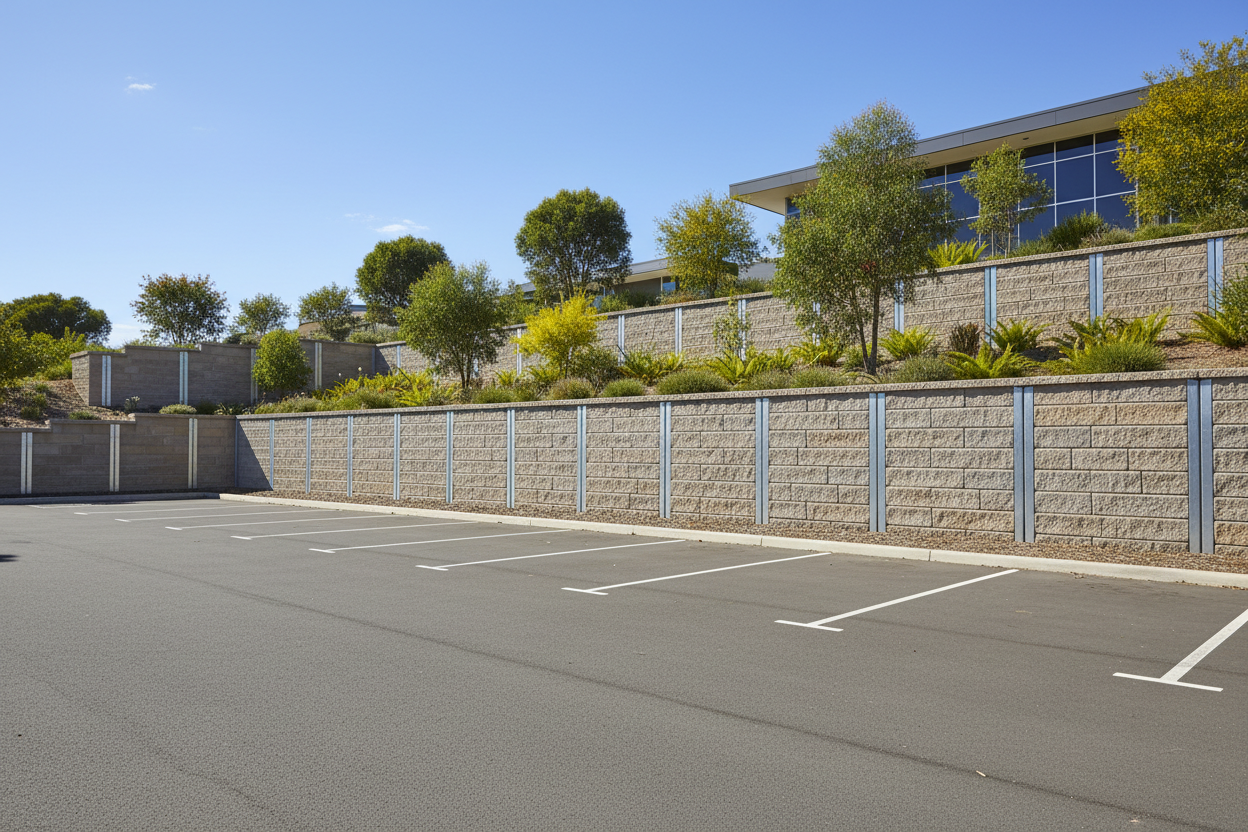
- Lifespan: 50+ years with no maintenance. Concrete does not rot, warp, or degrade in soil.
- Strength: 40MPa, 50MPa, and 60MPa options available. Significantly stronger than timber under lateral load.
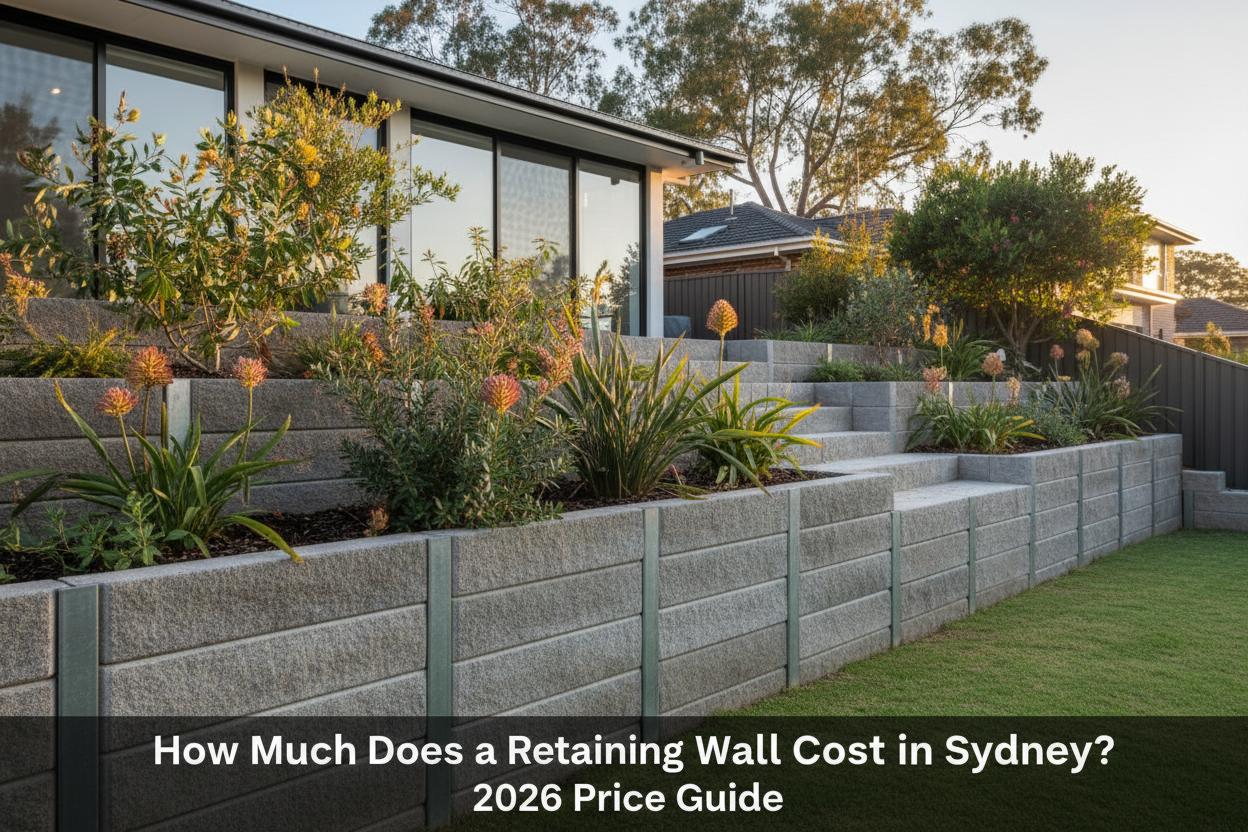
- Appearance: Available in a wide range of colours and textures including exposed aggregate, sandstone, and smooth finishes. See our concrete sleeper range.
- Low maintenance: No sealing, painting, or treatment required.
- Termite-proof: Concrete is not affected by termites — a significant advantage in Queensland, NT, and northern WA.
- Fire resistance: Concrete is non-combustible — important in bushfire-prone areas.
- Resale value: Concrete walls are viewed more favourably by buyers and valuers than timber.
Cons
- Higher upfront cost: 20–40% more expensive than treated pine at the point of purchase.
- Heavier: Requires machinery or more labour to handle on site.
- Less flexible for curves: Concrete sleepers are straight — curved walls require stepped construction.
Treated Pine Timber Retaining Walls — Pros and Cons
Pros
- Lower upfront cost: 20–40% cheaper than concrete sleepers at point of purchase.
- Lighter: Easier to handle manually on difficult access sites.
- Flexible: Can be cut and shaped more easily for curves and irregular layouts.
- Widely available: Available from most hardware stores and timber yards.
Cons
- Shorter lifespan: 15–25 years in typical Australian conditions. Less in wet or termite-prone areas.
- Maintenance required: Needs resealing every 3–5 years to maintain appearance and slow degradation.
- Rot and termite risk: Even H4 and H5 treated pine will eventually degrade in-ground, particularly in clay soils with poor drainage.
- Appearance degrades: Timber greys and weathers over time. Difficult to maintain original appearance.
- Replacement cost: When timber fails, the entire wall must be demolished and rebuilt — at full installation cost.
- Not suitable for walls over 1.0m: Timber is rarely specified for engineered walls over 1.0m due to lower structural capacity.
Which Is Better for Your Project?
Choose Concrete Sleepers If:
- You want a wall that lasts 50+ years without maintenance
- Your wall is over 1.0m in height
- You are in a termite-prone area (QLD, NT, northern WA)
- You are in a bushfire-prone area
- You want a premium finish that adds to property value
- You are building in clay soil with high moisture — see our soil types guide
- You are building a wall that requires engineering sign-off — see our engineering guide
Choose Timber If:
- You have a tight upfront budget and the wall is under 1.0m
- You need a temporary solution (e.g., during a staged landscaping project)
- The site has very difficult access and machinery cannot reach
- You are comfortable with ongoing maintenance and eventual replacement
Drainage — Same Requirement for Both
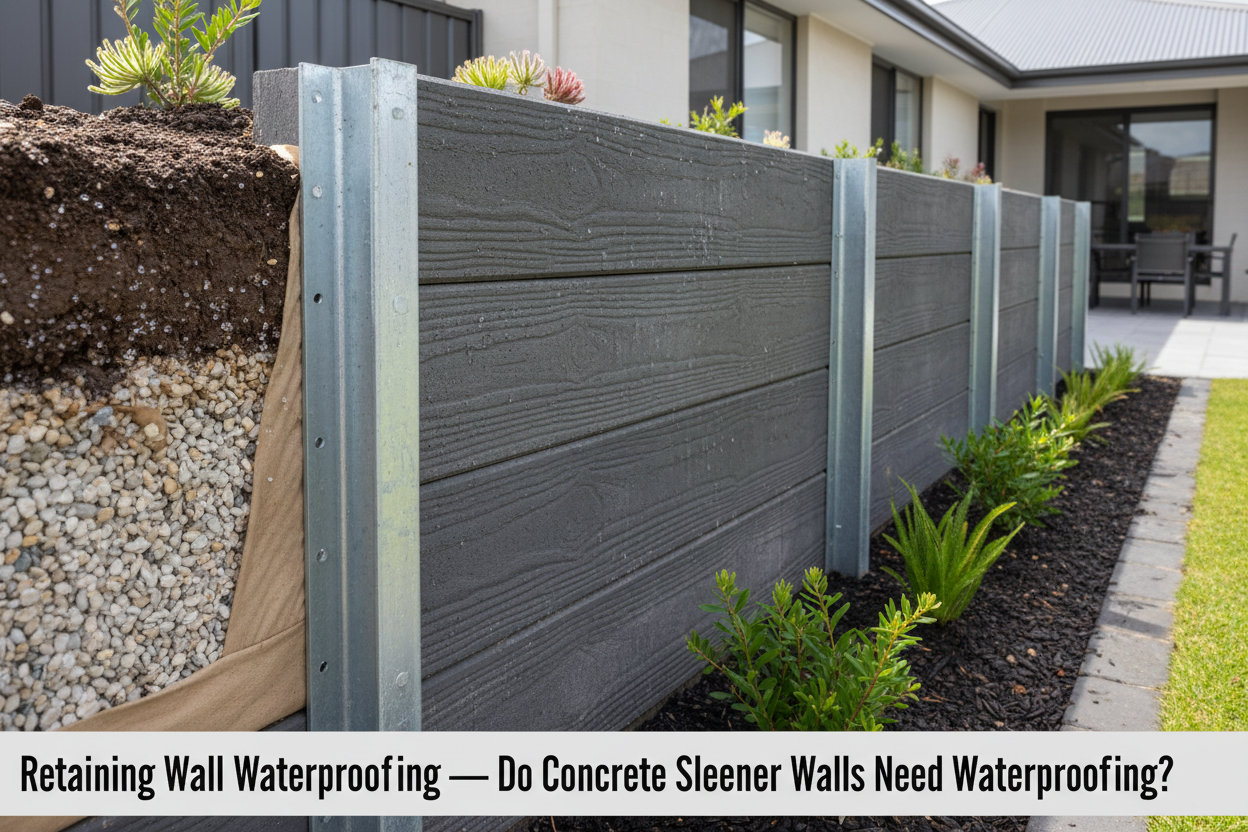
Both concrete sleeper and timber retaining walls require proper drainage — ag pipe, drainage gravel, geotextile fabric, and weep holes. Poor drainage is the number one cause of retaining wall failure regardless of material. See our complete drainage installation guide.
Post Selection — Same for Both Materials
Both concrete sleeper and timber sleeper walls use the same steel post system — C-channel for walls under 1.0m, H-beam for walls over 1.0m. The post selection is driven by wall height and loading, not sleeper material. See our H-beam vs C-channel guide and our complete steel post buyer's guide.
Council and Engineering Requirements
Council permit and engineering requirements are the same for both concrete and timber retaining walls — they are based on wall height, location, and loading, not material. See our engineering requirements guide and our state-by-state regulations hub.
Frequently Asked Questions
How long does a concrete sleeper retaining wall last?
50+ years in typical Australian conditions with no maintenance required. Concrete does not rot, warp, or degrade in soil.
How long does a timber retaining wall last in Australia?
15–25 years for H4 or H5 treated pine in average conditions. Less in wet soils, clay, or termite-prone areas. Timber walls in poorly drained clay soils can fail in as little as 10 years.
Is concrete or timber better for a retaining wall in Queensland?
Concrete is strongly recommended in Queensland due to the high termite risk. H4 treated pine provides some protection but is not termite-proof. Concrete is completely unaffected by termites.
Can I mix concrete sleepers and timber posts?
No. Concrete sleepers must be used with steel posts — either C-channel or H-beam. Timber posts are not suitable for concrete sleeper walls.
What is the best retaining wall material in Australia?
For most residential applications, concrete sleepers with hot-dip galvanised steel posts are the best long-term choice. They comply with AS4678-2002, require no maintenance, and outlast timber by 2–3 times.
Browse Our Concrete Sleeper Range
- All concrete sleepers
- Sydney & NSW concrete sleepers
- Melbourne & VIC concrete sleepers
- Brisbane & QLD concrete sleepers
- Perth & WA concrete sleepers
- Complete retaining wall kits — sleepers, posts, and drainage
Use our retaining wall calculator to estimate quantities, or contact our team for a free quote.
Related guides: National cost guide · Sydney cost guide · H-beam vs C-channel · Drainage guide · Soil types · Engineering guide · Calculator



Leave a comment (all fields required)