

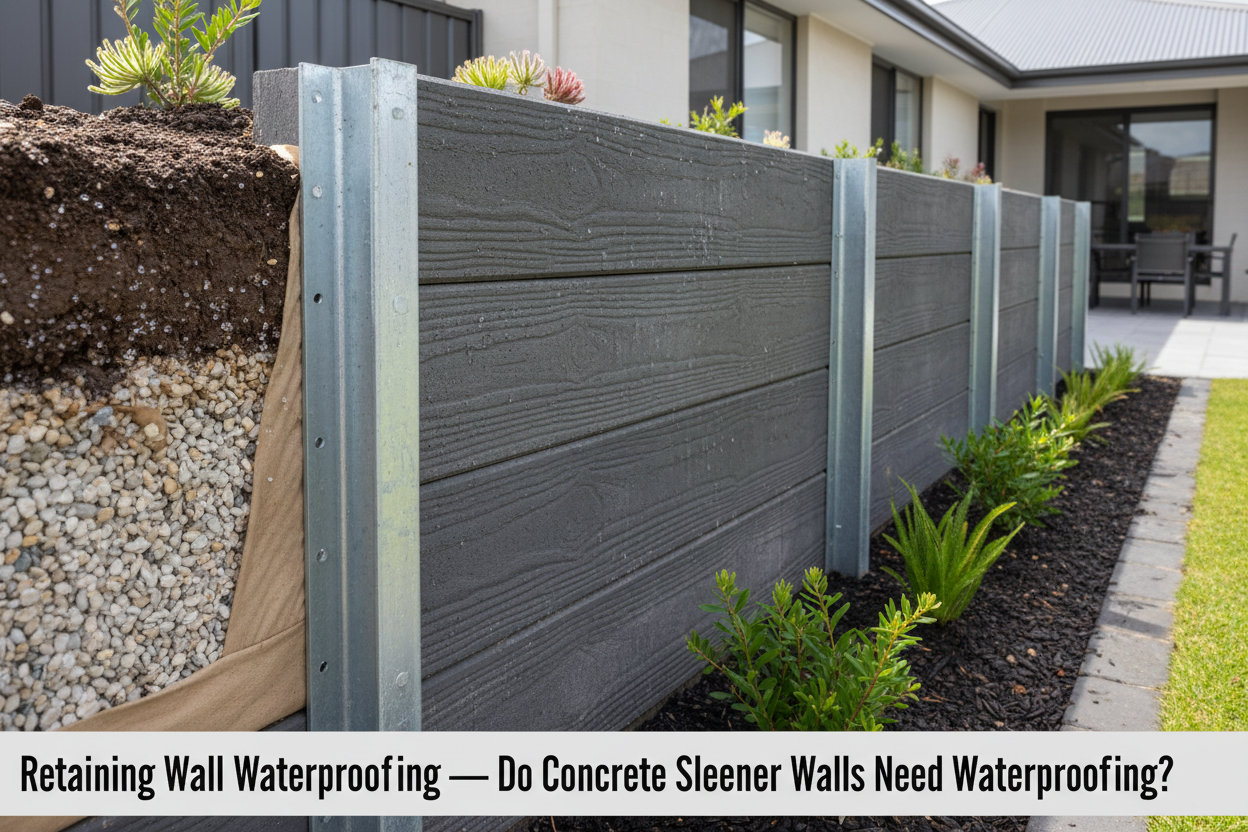

One of the most common questions from homeowners and builders planning a concrete sleeper retaining wall is: does it need to be waterproofed? The short answer is: in most residential applications, no — but it absolutely needs correct drainage. Waterproofing without drainage is ineffective. Drainage without waterproofing is usually sufficient.
With many years of hands-on retaining wall construction experience across Australia, I've seen waterproofing applied correctly, incorrectly, and unnecessarily. This guide explains when waterproofing adds value, what products are used, and why drainage is always the priority.
Key Point: Concrete sleeper retaining walls do not require waterproofing membranes in standard residential applications. What they require is correct drainage — ag pipe, drainage gravel, geotextile fabric, and weep holes. Drainage manages water. Waterproofing alone does not.
Why Drainage Matters More Than Waterproofing
The primary threat to a retaining wall is not water penetrating the concrete — it is hydrostatic pressure from water accumulating behind the wall. A waterproofing membrane on the face of the wall does nothing to reduce hydrostatic pressure. Only drainage removes water from behind the wall and eliminates the pressure.
See our complete guide on how to install drainage behind a retaining wall and our guide on why retaining wall drainage matters.
When Is Waterproofing Used on Retaining Walls?
Waterproofing is applied to retaining walls in specific situations:
- Basement retaining walls — where the wall forms part of a habitable or storage space and water ingress would cause damage to the interior
- Pool retaining walls — where the wall is adjacent to a pool and chlorinated water must be prevented from migrating into the retained soil
- Walls adjacent to buildings — where water migration through the wall could affect building footings or interiors
- Engineered walls in high water table areas — where a structural engineer specifies waterproofing as part of the design
- Walls with aesthetic requirements — where surface sealing is applied to improve appearance and reduce surface staining
For standard garden or boundary retaining walls, waterproofing is not required and is not typically specified by structural engineers. See our guide on when engineering is required.
Types of Waterproofing Used on Retaining Walls
1. Bituminous Waterproofing Membrane
A black bitumen-based membrane applied to the back face of the wall before backfilling. Used primarily on basement and below-ground retaining walls. Provides a barrier against water migration through the concrete. Must be used in conjunction with drainage — not as a substitute for it.
2. Crystalline Waterproofing
A cementitious product applied to the concrete surface that reacts with moisture to form crystals within the concrete matrix, blocking water pathways. Used on engineered walls where a high level of water resistance is required. More durable than bituminous membranes but more expensive.
3. Liquid Applied Membranes
Polyurethane or acrylic-based liquid membranes applied by brush or roller. Used on walls adjacent to buildings or pools. Flexible and able to bridge minor cracks. Requires surface preparation and primer.
4. Surface Sealers (Aesthetic)
Penetrating or film-forming sealers applied to the exposed face of concrete sleepers to reduce surface staining, efflorescence, and weathering. These are not structural waterproofing products — they improve appearance only and do not affect the structural performance of the wall.
Efflorescence — White Staining on Concrete Sleepers
Efflorescence is the white crystalline deposit that appears on the surface of concrete sleepers when water moves through the concrete and deposits calcium carbonate on the surface. It is a cosmetic issue, not a structural one. It does not indicate wall failure.
Efflorescence is more common in:
- New walls in the first 1–2 years as the concrete cures
- Walls with inadequate drainage where water is constantly moving through the concrete
- Walls in high-rainfall areas
Treatment: Efflorescence can be removed with a dilute acid wash (1 part hydrochloric acid to 10 parts water) followed by thorough rinsing. A penetrating sealer applied after cleaning will reduce recurrence. The long-term solution is correct drainage — see our drainage installation guide.
Retaining Wall Sealer — Is It Worth It?
Applying a penetrating concrete sealer to the exposed face of concrete sleepers is optional but can provide the following benefits:
- Reduces surface staining from soil, moss, and algae
- Reduces efflorescence
- Improves colour retention and appearance
- Makes the surface easier to clean
Sealers do not improve the structural performance of the wall and are not a substitute for drainage. Reapplication is typically required every 5–10 years depending on the product and exposure conditions.
Waterproofing vs Drainage — What to Prioritise
| Measure | Prevents Hydrostatic Pressure? | Prevents Water Ingress? | Required for Standard Walls? |
|---|---|---|---|
| Ag pipe drainage | Yes | No | Yes — always |
| Drainage gravel | Yes | No | Yes — always |
| Geotextile fabric | Indirectly | No | Yes — always |
| Weep holes | Yes (secondary) | No | Yes — always |
| Bituminous membrane | No | Yes | No — basement/pool walls only |
| Surface sealer | No | Partially | No — aesthetic only |
Waterproofing for Pool Retaining Walls
Retaining walls adjacent to swimming pools require special consideration. Chlorinated pool water migrating through the wall into retained soil can affect soil chemistry and nearby vegetation. In these applications, a waterproofing membrane on the pool-facing side of the wall is recommended, specified by the pool engineer or structural engineer.
Pool retaining walls also typically require engineering due to the surcharge load of the pool structure. See our guide on surcharge loads and our engineering requirements guide.
Waterproofing for Basement Retaining Walls
Basement retaining walls — where the wall forms part of an underground room or storage area — require full waterproofing treatment as part of the building design. This is specified by the structural engineer and typically involves a combination of:
- External waterproofing membrane on the retained side
- Drainage board or dimple mat to protect the membrane and direct water to the drainage system
- Ag pipe drainage at the base
- Internal drainage channel and sump pump as a secondary system
Basement waterproofing is a specialist trade and should be designed and installed by a licensed waterproofing contractor.
Frequently Asked Questions
Do concrete sleeper retaining walls need to be sealed?
No — sealing is optional and cosmetic only. Concrete sleepers are durable without sealing. If you want to reduce staining and efflorescence, a penetrating concrete sealer can be applied to the exposed face. It does not affect structural performance.
Why is my retaining wall leaking water?
Water seeping through or around a retaining wall is a drainage issue, not a waterproofing issue. The drainage system behind the wall is either absent, blocked, or undersized. See our guide on retaining wall drainage problems and fixes.
Can I waterproof an existing retaining wall?
You can apply a surface sealer to the exposed face of an existing wall. Applying a waterproofing membrane to the back face of an existing wall requires excavation, which risks destabilising the wall. The correct solution for an existing wall with water problems is to improve the drainage system. See our drainage problems guide.
What causes white stains on concrete sleepers?
White staining is efflorescence — calcium carbonate deposits left when water moves through the concrete. It is cosmetic only and does not indicate structural failure. Treat with dilute acid wash and apply a penetrating sealer. Improve drainage to reduce recurrence.
Do I need waterproofing if I have good drainage?
For standard garden and boundary retaining walls, good drainage is all that is required. Waterproofing membranes are only needed for basement walls, pool walls, or walls adjacent to buildings where water ingress would cause interior damage.
Complete Your Retaining Wall Drainage System
The most important investment you can make in your retaining wall is correct drainage. Browse our drainage range:
- Drainage kits — ag pipe, geotextile sock, and weep holes
- Geotextile fabric — for drainage zone lining
- Weep hole inserts — purpose-made for concrete sleeper walls
- Concrete sleepers — all sizes and finishes
- Complete retaining wall kits
Use our calculator · Contact our team
Related guides: Drainage installation · Why drainage matters · Drainage problems & fixes · Ag pipe guide · Geotextile fabric guide · Surcharge loads · Engineering guide · Calculator



Leave a comment (all fields required)