









Creative Retaining Wall Ideas: Stone, Rock-Face & Feature Finishes
Quick Answer: A retaining wall doesn't have to be purely functional. Textured, stone-look finishes - like Sandstone Block and Rock Face - and brick-style detailing can turn a structural necessity into a genuine feature of the garden. These finishes work best when used deliberately, on the section of wall that's actually seen, rather than applied uniformly across an entire property.
Why Finish is Worth Thinking About at all
It's easy to treat a retaining wall as a purely structural problem to solve - the right posts, the right sleeper strength, correct drainage - and stop there. But a retaining wall is often one of the largest single surfaces added to a property during a landscaping project, sometimes running for many metres along a boundary, driveway or garden edge. Once a wall exists, it's a permanent, highly visible part of the property for decades, which makes the finish decision worth roughly the same level of consideration as choosing paving, cladding or fencing elsewhere on the block.
The good news is that finish choice on a concrete sleeper and steel post system is almost entirely decoupled from structural performance. Whatever texture or colour sits on the face of the sleeper, the underlying reinforced concrete core and the post specification behind it stay the same. This means the creative decisions covered in this guide can be made on appearance alone, without needing to weigh them against engineering considerations the way post size or footing depth would need to be.
Stone-Look Finishes: Sandstone Block
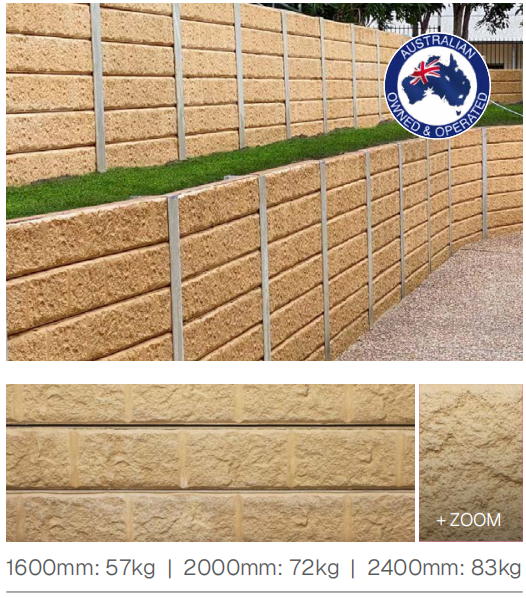
A Sandstone Block finish replicates the look of cut sandstone masonry, giving a wall a heavier, more established feel than a plain concrete face. It works particularly well where a natural stone look is wanted without the cost and complexity of sourcing and laying real stone.
- Suits coastal properties and civil-style landscaping where a natural material look fits the surroundings
- Pairs well with natural stone paving, exposed aggregate driveways and other textured hard-landscaping
- Gives a heritage or established character to a newly built wall
- Reads well at a distance as well as up close, since the block-jointed pattern remains legible even on a longer wall run viewed from across a garden or street
Sandstone Block finishes are also a common choice on properties where the surrounding architecture already leans toward a more traditional or established look - period homes, sandstone-clad facades, or gardens with mature plantings where a stark, contemporary concrete face would feel out of place against the rest of the setting.
Textured Finishes: Rock Face
A Rock Face finish uses a heavily textured, irregular surface to break up what would otherwise be a flat, uniform wall face. It's particularly effective on longer wall runs, where a single smooth or charcoal surface can start to look flat and repetitive across a long distance.
- Adds visual interest and shadow play across the wall face as light changes through the day
- Works well as a feature section within a longer wall, rather than necessarily the whole run
- Not tied to a specific regional style - a genuinely national option for adding texture
- Helps disguise minor surface variation between individual sleepers, since an irregular texture is more forgiving of small inconsistencies than a perfectly flat, smooth finish
The shadow-play effect worth calling out specifically: a heavily textured surface catches low-angle morning and evening light very differently to a flat one, throwing small shadows across each raised section of the texture. On a long wall run that gets direct sun for part of the day, this can make the wall feel genuinely alive and changing through the day, rather than a static backdrop - an effect a flat finish simply can't replicate regardless of colour.
Brick-Style Detailing and Design
Some projects combine a concrete sleeper and post system with brick detailing elsewhere in the landscape design - matching brick piers, capping, or garden edging to tie the retaining wall into a broader brick-based property. The sleeper and post system itself stays the same regardless of what surrounding brickwork or landscaping detail is used alongside it.
This approach suits properties where brick is already a dominant material - matching brick tones in surrounding features can help a concrete retaining wall feel like a deliberate part of the overall design rather than a separate, unrelated structure. A few common ways this pairing shows up in practice:
- Brick piers at post locations - a decorative brick sleeve or pier built around selected posts, particularly at corners or the ends of a wall run, giving the impression of a masonry structure while the actual retaining work is still done by the steel post underneath
- Brick capping along the top of the wall - a course of matching brick laid along the top edge of the sleeper wall, softening the transition between the concrete face and any brick fencing or garden edging above it
- Brick garden edging tying into the wall - shorter runs of brick edging elsewhere in the garden, colour-matched to any brick detailing on the retaining wall itself, to create a consistent material palette across the property
Because the sleeper and post system does all the structural work, these brick details are purely decorative additions and can generally be planned or added without affecting the underlying wall specification - though it's worth confirming with whoever is building the wall that any brick detailing won't interfere with drainage, weep holes or post positions.
Combining Finishes Across a Single Property
A property doesn't need to use one finish for every retaining wall on the site. In fact, using a single feature finish deliberately - rather than applying the same texture everywhere - is often what makes a finish choice look intentional rather than incidental. A common approach on larger properties with multiple retaining structures:
- A standard, plain finish - smooth or charcoal - for hidden side walls, walls behind garages, or purely functional level changes that aren't seen from living areas or the street
- A feature finish - Sandstone Block, Rock Face, or brick detailing - reserved for the wall or section of wall that's actually on display, such as an entry wall, a wall visible from an outdoor living area, or a driveway wall facing the street
- A consistent finish across walls that are visible from the same vantage point, even if they were built at different times, to avoid an obviously mismatched look between two nearby retaining structures
This mixed approach also has a practical cost benefit, since feature finishes typically carry a modest premium over standard options - reserving the premium finish for the sections that will genuinely be seen keeps the overall project more cost-effective than applying it uniformly across every wall on the property.
Where a Feature Finish Works Best
Feature finishes have the most impact when used with intention, rather than applied everywhere by default:
- Street-facing walls or entry features, where the wall is genuinely on display
- A single accent section within a longer wall, rather than the entire run
- Areas near outdoor living spaces, where the texture and detail will actually be seen and appreciated up close
- Sections of wall that double as a backdrop for other features - a water feature, sculpture, or garden lighting - where the texture adds depth to the overall composition
For hidden side walls or purely functional sections, a plainer finish is often the more sensible choice - saving the feature treatment for where it will genuinely be noticed.
Common Mistake: Choosing Texture Without Checking the Wider Context
A heavily textured finish that looks striking as a standalone sample can occasionally clash with an otherwise minimalist or contemporary property. Before committing to a stone-look or rock-face finish, it's worth checking it against the same considerations covered in our choosing a style guide - viewing a sample in natural light, at the actual location, before finalising the decision.
A few related traps worth avoiding specifically when choosing a feature finish:
- Judging a texture purely from a small sample or photo - a small chip of Rock Face or Sandstone Block finish can look quite different once scaled up across a full wall run, particularly in terms of how the shadow pattern reads at a distance
- Choosing a finish based on a display wall in a different climate or light condition - a finish that looks warm and inviting under a display yard's lighting can read differently under harsher midday sun or in a shaded, south-facing section of a property
- Mixing too many feature elements at once - combining a heavily textured Rock Face finish with brick detailing and a strongly contrasting capping material in the same wall can start to compete visually rather than reading as a single, deliberate design choice
Matching a Finish to your Property's Existing Style
The most successful feature finishes tend to be chosen in relation to what's already on the property, rather than in isolation. A few starting points depending on the existing style of a home and garden:
- Coastal or beach-house properties - Sandstone Block or a lighter-toned finish generally sits well against timber decking, weatherboard cladding and coastal planting, reinforcing a relaxed, natural material palette
- Contemporary or minimalist homes - a smooth or charcoal finish is often the safer default, since heavily textured finishes can occasionally compete with the clean lines a minimalist design is going for; where texture is still wanted, a single accent section rather than a full feature wall tends to work better
- Character or heritage properties - Sandstone Block or brick-detailed sections can echo existing masonry on the home itself, helping a new retaining wall feel period-appropriate rather than obviously modern
- Bushland or acreage properties - Rock Face finishes often suit these settings particularly well, since the irregular, natural-looking texture sits comfortably against native planting and less formal garden layouts
None of these are strict rules - a contemporary home with a single Rock Face accent wall near an outdoor entertaining area can look just as considered as a fully textured heritage-style wall, provided the finish is chosen deliberately rather than picked without reference to what's already there.
Maintenance Considerations for Textured and Feature Finishes
Feature finishes generally don't require different maintenance from a standard sleeper finish, but their texture can interact with dirt, moss and garden growth slightly differently, which is worth being aware of over the life of the wall.
- Heavily textured finishes like Rock Face have more surface area and more recessed detail than a smooth face, which can collect dust, pollen or light moss growth over time in shaded, damp positions
- A periodic wash-down with a garden hose or low-pressure washer is usually enough to keep a textured finish looking sharp, though it's worth checking any specific care guidance for the finish before using a pressure washer at close range
- Lighter-toned finishes such as Sandstone Block can show staining from mulch, soil splashback or garden run-off more visibly than a darker charcoal finish, so keeping garden beds and mulch a short distance back from the wall face helps keep a lighter finish looking clean for longer
- Brick detailing, if used, should be checked periodically for pointing or mortar condition in the same way as any other brickwork on the property, independent of the concrete sleeper system it sits alongside
None of this maintenance is unique to feature finishes specifically - it's the same general care any exterior masonry or concrete surface benefits from - but it's worth factoring into the decision if a very low-maintenance wall is a priority alongside the aesthetic outcome.
Planning a Feature Wall Alongside other Landscaping Elements
Because a feature finish is often chosen to work with surrounding hard-landscaping, it's worth sequencing the decision alongside other material choices on the project rather than finalising it in isolation. A few practical questions to work through before ordering:
- Has paving, decking or cladding already been chosen elsewhere on the property, and does the proposed wall finish complement or clash with those existing tones and textures
- Will garden lighting be installed near the wall, since a textured finish like Rock Face can look particularly effective with grazing light washed across the surface at night
- Is planting planned directly in front of the wall, and if so, will it eventually obscure a feature finish that's meant to be seen - a lower-growing plant selection may be worth considering if the finish itself is the intended feature
- Does the wall need to tie into an existing fence, pier or gate detail, in which case matching or complementary brick or capping detail may be worth planning from the outset rather than adding later
Working through these questions early tends to produce a more cohesive result than choosing a wall finish as a standalone decision and fitting the rest of the landscaping around it afterwards.
Browse the Range
Our concrete sleeper range includes both Sandstone Block and Rock Face finishes alongside the standard options, worth a browse to compare textures side by side. You can also go directly to the sandstone finish range.
For the full list of ideas this guide sits alongside, see our main retaining wall ideas guide.
FAQs
Does a textured finish like Rock Face affect the wall's strength?
No. Texture is applied to the surface during casting and doesn't change the sleeper's underlying strength, reinforcement or dimensions. Choose a textured finish for its look, not for any structural difference.
Should I use a feature finish on the whole wall or just part of it?
There's no fixed rule, but feature finishes often have more impact used deliberately on a visible section - a street-facing run or entry feature - rather than applied uniformly across an entire property, including hidden or purely functional sections.
Can a stone-look finish be combined with brick landscaping features?
Yes. The sleeper and post system works independently of surrounding brick detailing, so it's practical to pair a Sandstone Block or other textured finish with brick piers, capping or garden edging elsewhere in the design.
Is Rock Face finish suited to a particular climate or region?
Not specifically - it's a genuinely nationwide option rather than a finish tied to one climate or region. Its usefulness comes from breaking up long, flat wall runs, which applies regardless of location.
Can I use different finishes on different walls across the same property?
Yes, and it's a common approach. A standard finish is often used on hidden or purely functional walls, while a feature finish is reserved for the section of wall that's actually visible - such as an entry wall or a driveway wall facing the street.
Should I view a physical sample before choosing a feature finish?
It's worth it where possible. A small sample or photo doesn't always represent how a texture will read at full scale, or how it will look under your property's specific light conditions, so viewing a sample in natural light at the actual location helps avoid a mismatch after the wall is built.
Do textured or feature finishes need more maintenance than a standard finish?
Not significantly, though heavily textured finishes can collect dust or light moss in shaded, damp spots due to their extra surface detail, and lighter-toned finishes can show soil or mulch staining more visibly than darker ones. A periodic wash-down is usually enough to keep either looking sharp.
Leave a comment (all fields required)