








Quick answer: A precast concrete plinth and a timber plinth board do the same basic job under a Colorbond fence - closing the ground gap and giving the fence a level base - but they age very differently. Concrete doesn't rot, doesn't move with reactive clay, and needs zero maintenance over the life of the fence. Timber board is lighter and easier for a DIYer to cut to an odd length, but it's exposed to exactly the ground contact and moisture that makes timber fail first, and it's the more likely of the two to need replacing before the Colorbond fence itself does.
Two Genuinely Different Products Solving the Same Problem
Both a precast concrete plinth and a timber plinth board - the kind commonly sold at hardware retailers as a fencing accessory - sit at the base of a fence line to close the gap between the bottom rail and uneven ground. Beyond that shared purpose, the two products are built from materials with very different long-term behaviour, and that difference matters more under a Colorbond fence than it might first seem.
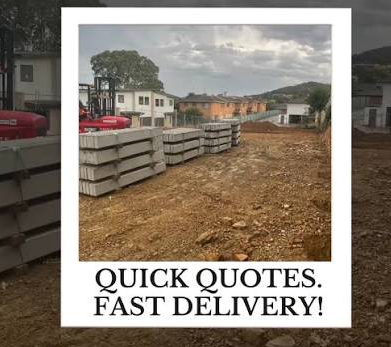
- Precast concrete plinth - a reinforced concrete strip, typically around 2340mm long, 200mm high and 50mm thick, cast with a steel reo bar running its length
- Timber plinth board - a length of treated timber or composite board, cut to size on site, sitting in the same position at the base of the fence
This is a fair, materials-focused comparison rather than a case against any specific retailer's product - the point is the underlying material difference between concrete and timber, which holds regardless of which hardware supplier a timber board happens to come from.
Side-by-Side Summary
| Factor | Precast Concrete Plinth | Timber Plinth Board |
|---|---|---|
| Rot resistance | Not applicable - no organic material to decay | Vulnerable at ground contact, even when treated |
| Termite risk | None | A genuine access point in termite-prone areas |
| Reactive clay performance | Steel-reinforced, handles minor ground movement well | Can crack or bow as rigid board meets shifting ground |
| Weight / handling | Heavier - typically a two-person job to position | Light enough for one person to handle easily |
| Cutting to fit | Ordered close to correct length; not cut on site | Easily cut to an odd bay length with standard tools |
| Colour stability | Integral colour, doesn't fade or need resealing | Greys and weathers with UV exposure over time |
| Typical service life | Comparable to the fence itself | Often shorter than the Colorbond fence above it |
Durability: Where the Two Materials Actually Diverge
The core difference between these two products isn't how they look on day one - it's how they behave after several years of ground contact, weather and soil movement, which is exactly the environment a plinth sits in permanently.
- Rot and moisture - a plinth sits directly on or partly in the ground, which is the single worst position for untreated or even treated timber, since it's in near-constant contact with damp soil. Concrete has no organic material for moisture to break down, so this failure mode simply doesn't apply to it
- Termites - timber at ground level along a fence boundary is a realistic termite access point in many parts of Australia. Concrete gives termites nothing to feed on
- Reactive clay movement - on reactive clay soils, which expand and contract significantly with moisture, a rigid timber board can crack or bow as the ground shifts beneath it. A concrete plinth, reinforced internally with steel bar, handles this kind of minor ground movement without the same risk of splitting
- UV and weathering - timber greys, checks and can splinter with UV exposure over time unless it's periodically resealed. Concrete's integral colour runs through the material and doesn't fade or require resealing

None of this means timber is a poor product in every application - it's a perfectly reasonable choice for many general fencing uses. Under a fence line specifically, though, where the plinth sits at ground level for the full life of the fence, these are the conditions where the material difference shows up fastest.
How Climate and Region Change the Comparison
The gap between concrete and timber performance isn't uniform across Australia - it widens or narrows depending on the specific conditions a plinth is exposed to in a given region, which is worth factoring in alongside the general durability points above.
- Humid subtropical and tropical areas (Queensland, northern NSW) - sustained moisture and warmth are close to ideal conditions for both rot and termite activity, which makes the durability gap between concrete and timber wider here than almost anywhere else in the country
- Reactive clay belts (Melbourne's south-east, western Sydney, parts of Adelaide) - the seasonal expansion and contraction of clay soils puts repeated mechanical stress on anything rigid sitting at ground level, which is where a timber board's tendency to crack or bow shows up fastest
- Coastal and sandy soil areas (Perth, coastal Queensland) - sandy soils drain faster and hold less moisture than clay, which is somewhat kinder to timber, but salt-laden coastal air brings its own weathering and corrosion considerations for any fixings used to secure a timber board
- Drier inland and alpine regions - lower average moisture reduces rot risk for timber somewhat, though UV exposure and temperature swings still take a toll on an unsealed or infrequently maintained board over time
In every one of these regions, concrete's performance stays essentially constant, since none of these conditions meaningfully affect a steel-reinforced concrete plinth the way they affect timber. That consistency - not needing to think about regional conditions at all - is itself one of the quieter advantages of choosing concrete.
Compatibility with Colorbond Fences Specifically
Both products are physically compatible with a Colorbond fence line - neither requires a different fence system to work. The practical difference shows up more in how each interacts with the fence over time rather than at the point of installation.
- A concrete plinth gives a Colorbond fence a genuinely stable base that won't shift, warp or need re-levelling once it's set
- A timber board can move slightly as it dries out, swells or is affected by ground movement, which can translate into a small amount of movement transferred to the bottom of the fence panel sitting on it
- Because Colorbond sheeting itself doesn't rot, pairing it with a timber plinth board means the plinth becomes the shorter-lived component in the system, rather than the fence and the plinth ageing at a similar rate
Installation Differences
This is genuinely one area where timber board has a practical edge, particularly for a DIY installer working alone.
- Weight - a timber board is significantly lighter to handle and position than a precast concrete plinth of the same length, which matters if you're fitting it solo without help lifting
- Cutting to length - timber can be cut on site with standard tools to fit an odd bay length or a corner. A concrete plinth generally needs to be ordered close to the correct length in the first place, since cutting it on site isn't practical without specialist equipment
- Fixing - timber board is straightforward to screw or nail into position against existing posts. A concrete plinth is set in place rather than fixed with fasteners, which suits a new fence build more naturally than an awkward retrofit around existing fixings
For the step-by-step process of fitting a concrete plinth specifically, including how to work around existing Colorbond posts and rails, see our guide on installing a concrete plinth under a Colorbond fence.
Sustainability and Ongoing Waste Considerations
Worth a brief mention alongside durability, since the two are closely related: a product that needs replacing multiple times over the life of a fence also generates more waste over that same period than a product installed once. A timber board that fails and is replaced every several years produces a cycle of removal, disposal and re-purchase that a single, long-lived concrete plinth avoids entirely. This isn't the deciding factor for most buyers, but it's a genuine secondary consideration for anyone weighing the two options with an eye on minimising ongoing material turnover, not just upfront cost.
Thinking About Long-Term Value, Not Just the Purchase
The two products aren't priced the same, and pricing genuinely matters in this decision - but this article deliberately isn't the place to compare dollar figures, since plinth pricing depends on length, finish and delivery in ways that deserve their own dedicated breakdown. If you want the specific cost detail, see our guide on what a Colorbond fence plinth costs.
What's worth weighing here instead is value over the life of the fence rather than the upfront figure alone. A timber board that needs replacing once or twice over the life of a Colorbond fence - itself rated for decades of service - carries a repeat cost and a repeat labour job that a concrete plinth, installed once, generally doesn't. Whether that trade-off matters to you depends on how long you plan to own the property and how much a lower upfront cost is worth against avoiding a future replacement job.
Which Situation Actually Suits Which Product
Rather than treating this as a single universal answer, it's worth being honest that each product suits a slightly different set of circumstances.
- Concrete tends to suit - a long-term ownership situation, a property in a humid, termite-prone or reactive clay area, a new fence build where the plinth can be set in first, and anyone who wants to install a plinth once and not think about it again
- Timber board tends to suit - a short-term or budget-conscious fix, a rental property where the horizon for ownership is shorter, an odd-shaped bay or corner that's awkward to fit a fixed-length concrete unit into, and a confident DIYer working solo who values the lighter weight
Neither of these is a hard rule, and plenty of properties reasonably choose either option depending on their own priorities - but framing the decision around your actual situation, rather than treating one product as universally correct, tends to produce a better outcome than picking based on habit or whichever option happens to be more visible on a hardware store shelf.
Spotting Early Signs a Timber Board Is Starting to Fail
If you're currently deciding between the two products because an existing timber plinth is showing its age, it's worth knowing what early failure actually looks like, since catching it early makes the eventual replacement job much simpler than waiting until the board has fully given way.
- Softening at ground level - press gently along the base of the board with a screwdriver or similar tool. Timber that gives noticeably more at the base than higher up is already losing structural integrity from moisture
- Discolouration and dark staining - a darkened band running along the bottom edge of the board, often accompanied by a slightly different texture, is a common early rot indicator well before the timber visibly crumbles
- Small holes or sawdust-like debris - fine, powdery debris at the base of the board, or small round exit holes, can indicate termite or borer activity rather than straightforward rot, and is worth having assessed rather than assumed
- A widening gap beneath the fence - if the board has started to sag, shrink or pull away from the ground it was originally snug against, that movement is itself a sign the timber's structural condition has changed since installation
If you're dealing with a plinth that's already failed rather than just showing early signs, our guide on replacing a damaged or rotten plinth covers how to swap it out section by section without needing to dismantle the fence itself.
Can You Mix Concrete and Timber Along the Same Fence Run?
It's a fair question, particularly where a fence line is being upgraded gradually rather than all at once, or where one section has failed and the rest of the run still looks sound. Technically, yes - there's no structural reason concrete and timber plinths can't sit along different sections of the same boundary. Visually, it's a more mixed outcome worth thinking through before committing to a partial upgrade.
- A visible material change partway along a fence line - concrete for one stretch, timber for another - reads as an unfinished or patchwork job more than a deliberate design choice, in a way that mixing plinth colours generally doesn't
- Where budget only allows replacing the worst-affected section now, it's worth treating that as a staged upgrade with a plan to complete the rest in concrete later, rather than a permanent mixed arrangement
- If a genuinely permanent mixed approach is the goal - for example, concrete on a highly visible front section and timber on a low-visibility rear boundary - that's a reasonable compromise, provided it's a deliberate decision rather than an unplanned outcome of doing the visible section first and never getting to the rest
Common Mistake: Assuming "Treated" Timber Solves the Ground-Contact Problem
Treated timber is more resistant to rot and termites than untreated timber, but treatment slows these failure modes rather than eliminating them, particularly at a cut end or a fixing point where the treatment doesn't fully penetrate. A plinth board is cut to length on site more often than not, which means at least one end is frequently an untreated cut face sitting in permanent ground contact - exactly the weak point most likely to fail first.
FAQs
Is a concrete plinth better than a timber plinth board under a Colorbond fence?
For durability, generally yes - concrete doesn't rot, isn't a termite food source, and handles reactive clay movement better than a rigid timber board. Timber board is lighter and easier to cut to an odd length, which suits some DIY retrofits better.
Does a timber plinth board rot faster under a Colorbond fence than under a timber fence?
The rot risk comes from the plinth's own ground contact rather than the fence material above it, so a timber board rots at a similar rate under either fence type. The mismatch is more noticeable under Colorbond specifically, since the fence itself doesn't age the same way the timber plinth does.
Does my climate or soil type change which option is better?
Yes. Humid, termite-prone regions and reactive clay areas widen the durability gap in concrete's favour. Drier, sandier soils are somewhat kinder to timber, though concrete's performance stays consistent regardless of region.
Can I install a concrete plinth myself, or do I need a professional?
A confident DIYer can generally install a concrete plinth, though its weight makes it more of a two-person job than fitting a timber board. See our installation guide for the full process.
Which option costs more upfront?
A timber board is typically the cheaper upfront purchase. For the specific cost breakdown of a concrete plinth, including what drives the price, see our dedicated cost guide.
Does reactive clay soil make a difference to this decision?
Yes. On reactive clay, ground movement is more pronounced and more frequent, which is exactly the condition where a rigid timber board is more likely to crack or bow than a steel-reinforced concrete plinth.
Is a timber plinth board ever the more sensible choice?
Yes, in some situations - a short-term ownership horizon, a rental property, an odd bay shape awkward for a fixed-length concrete unit, or a solo DIYer who values lighter handling can all be reasonable grounds to choose timber, provided the trade-off in longevity is understood upfront.
Browse the Range
Our under-fence plinth range covers both standard concrete finishes. If you're weighing concrete against a steel or aluminium system instead of timber, see our comparison of concrete vs steel plinths, and for the full picture on plinths generally, start with our Under-Fence Plinths: Complete Guide.
Leave a comment (all fields required)