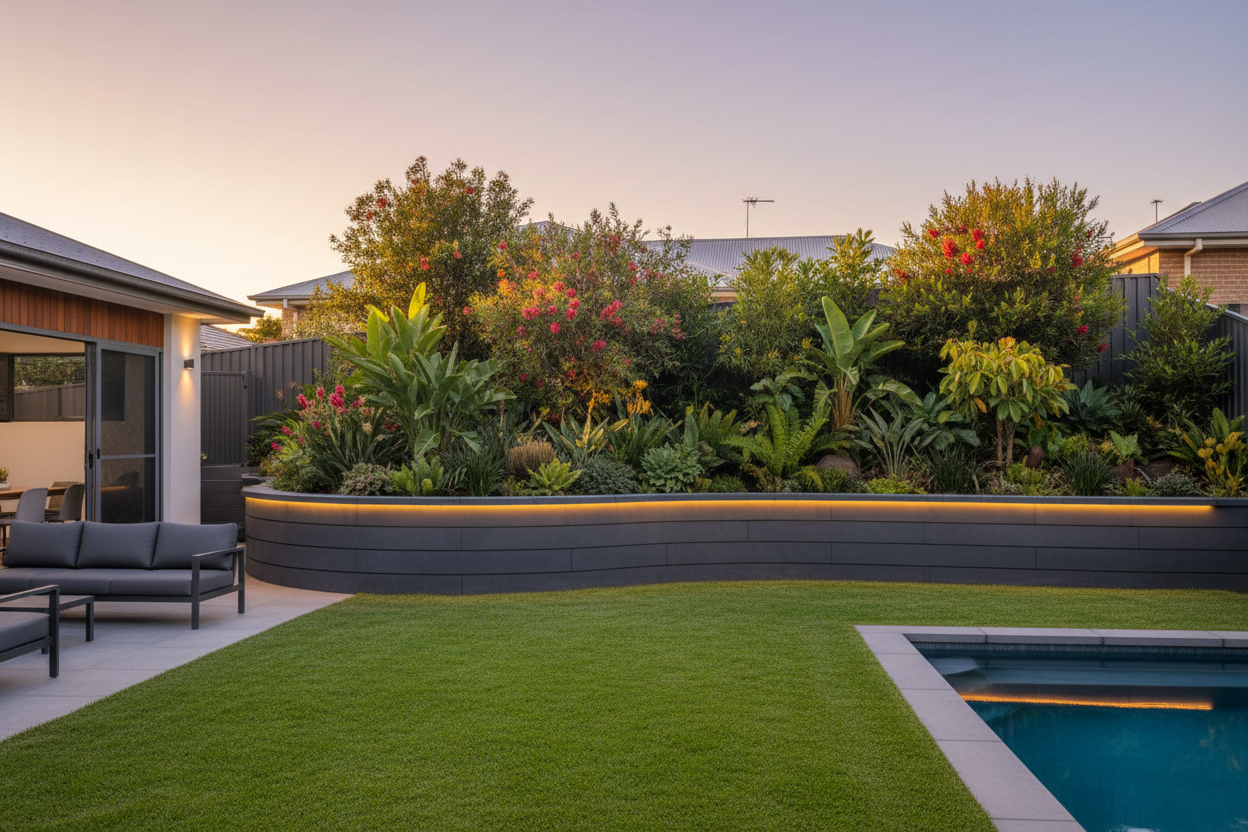

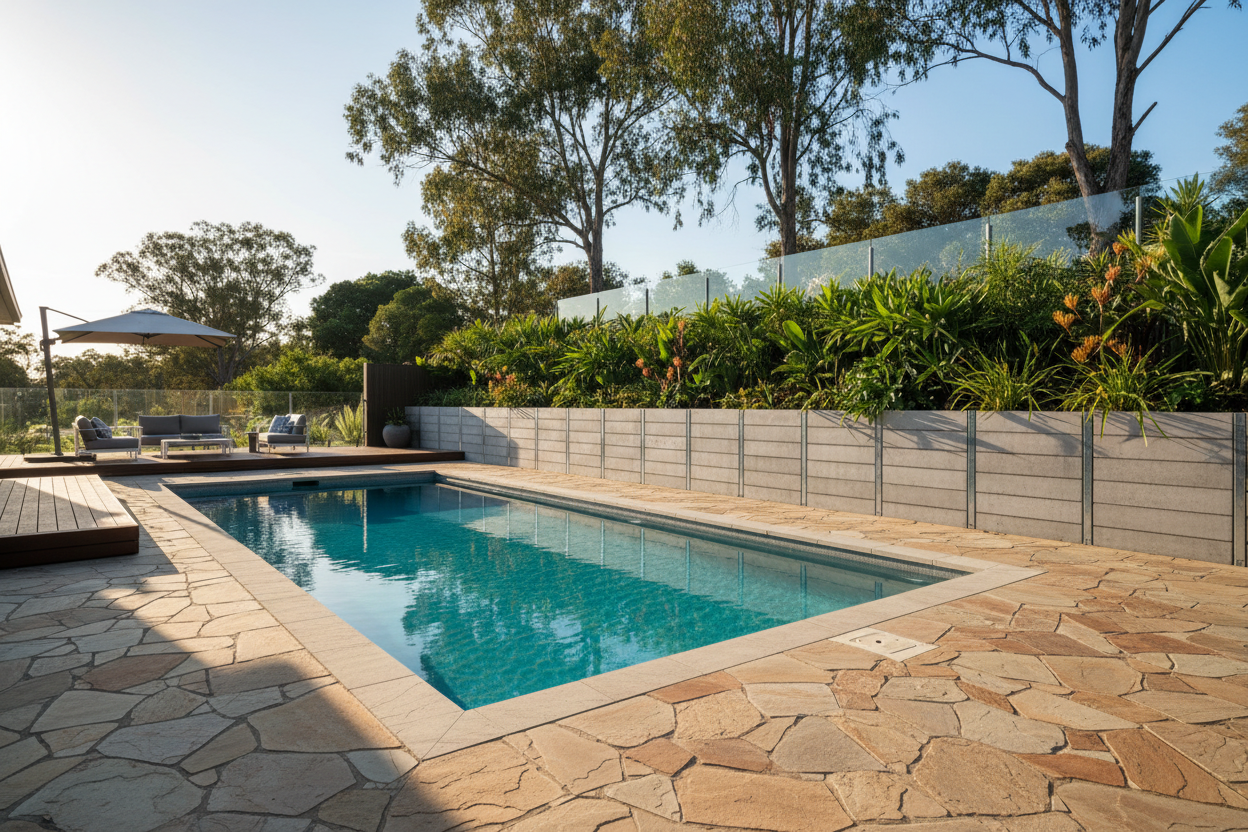

Swimming pools and retaining walls frequently appear together on Australian residential properties — pools are often built on sloping sites where retaining walls are needed to create level areas, or pools are built adjacent to existing retaining walls. The combination creates specific engineering and drainage challenges that need to be understood before specifying either the pool or the wall.
Why Pools and Retaining Walls Are a Complex Combination
A swimming pool adjacent to a retaining wall creates two significant challenges:
1. Pool Surcharge Load
A swimming pool is a heavy structure. A standard residential pool (8m x 4m, 1.5m average depth) contains approximately 48,000 litres of water, weighing approximately 48 tonnes. The pool shell itself adds further weight. When a pool is located above or adjacent to a retaining wall, this load is transferred through the pool's footings into the soil and adds to the lateral pressure on the wall.
The closer the pool is to the top of the retaining wall, the greater the surcharge effect. A pool located immediately above a retaining wall is one of the most demanding surcharge load scenarios in residential construction.
2. Pool Water Drainage
Pools leak — not necessarily from structural defects, but from normal operation: backwash, splash-out, overflow, and minor seepage through the pool shell over time. Pool water that enters the soil behind a retaining wall adds to the hydrostatic pressure on the wall. In clay soils, this can be significant.
Pool water also contains chlorine and other chemicals that can affect the soil chemistry and, over time, the concrete and steel components of the retaining wall. This is generally a low-level concern for standard residential pools, but it is worth noting.
Engineering Is Required
For any retaining wall adjacent to or below a swimming pool, a licensed structural engineer's specification is required. This is not a situation where rule-of-thumb specifications are adequate. The pool surcharge load is a specific engineering input that requires calculation, and the interaction between the pool structure, the soil, and the retaining wall needs to be assessed by a professional.
In most Australian states, a retaining wall adjacent to a pool will require council approval and engineering certification regardless of wall height. The pool itself requires council approval and engineering certification, and the retaining wall is typically assessed as part of the pool development application.
Typical Specification for Pool Retaining Walls
While the specific specification must be confirmed by a structural engineer for your site, pool retaining walls typically require:
- H-beam universal column posts — the standard post specification for walls with significant surcharge loads. See our H-beam post range.
- 200x100mm heavy duty sleepers — the standard sleeper specification for walls with surcharge loads. See our 100mm sleeper range.
- Reduced post spacing — typically 1.5–1.8m centres or less, confirmed by engineer.
- Increased post embedment depth — greater than the standard one-third rule, confirmed by engineer.
- Comprehensive drainage system — ag pipe, geotextile fabric, generous drainage aggregate, and weep holes. See our drainage kits.
Setback Between Pool and Retaining Wall
The required setback between a swimming pool and a retaining wall depends on the pool size, the wall height, the soil conditions, and the post specification. There is no universal minimum setback — this must be determined by a structural engineer for your specific site.
As a very rough guide, a setback of at least 1.5–2.0 times the wall height between the pool edge and the top of the retaining wall significantly reduces the surcharge effect. However, this is not a substitute for engineering assessment — it is a starting point for discussion with your engineer.
Drainage for Pool Retaining Walls
Drainage is critical for retaining walls adjacent to pools. The drainage system must handle:
- Normal groundwater and rainfall infiltration
- Pool backwash and splash-out
- Pool overflow during heavy rain (if the pool overflows toward the wall)
- Any seepage from the pool shell over time
The drainage system should be designed to handle peak flow from all these sources simultaneously. For pool retaining walls, a generous drainage aggregate zone (500mm or more behind the sleepers), correctly sized ag pipe, and multiple weep holes are the minimum. The drainage design should be confirmed by the structural engineer as part of the wall specification.
Council Approval for Pool Retaining Walls
In most Australian states, a retaining wall adjacent to a swimming pool requires council approval as part of the pool development application. The retaining wall is typically assessed as part of the pool DA or building permit, and engineering certification for the wall is required as part of the pool approval documentation.
Do not build a retaining wall adjacent to a pool without confirming approval requirements with your local council and coordinating with the pool engineer and certifier.
Existing Retaining Walls and New Pools
If you are building a new pool adjacent to an existing retaining wall, the existing wall must be assessed by a structural engineer before the pool is built. The engineer will determine whether the existing wall has adequate capacity to handle the pool surcharge load, or whether the wall needs to be upgraded or replaced before the pool can be built.
Do not assume an existing retaining wall is adequate for a pool surcharge load without engineering assessment. A wall that was adequate for its original purpose may not be adequate for the additional load from a pool.
Frequently Asked Questions
Do I need an engineer for a retaining wall near my pool?
Yes. For any retaining wall adjacent to or below a swimming pool, a licensed structural engineer's specification is required. The pool surcharge load is a specific engineering input that requires calculation, not estimation.
How close can a pool be to a retaining wall?
There is no universal minimum setback — this must be determined by a structural engineer for your specific site. As a rough guide, a setback of at least 1.5–2.0 times the wall height significantly reduces the surcharge effect, but this is not a substitute for engineering assessment.
Can pool water damage a retaining wall?
Pool water that enters the soil behind a retaining wall adds to the hydrostatic pressure on the wall. In clay soils, this can be significant. Pool chemicals (chlorine) can affect soil chemistry over time but are generally a low-level concern for standard residential pools. Proper drainage is the most important protection against pool water affecting the retaining wall.
Do I need council approval for a retaining wall near a pool?
Yes, in most cases. Retaining walls adjacent to pools typically require council approval as part of the pool development application. Confirm requirements with your local council and coordinate with the pool engineer and certifier.
Discuss Your Pool Retaining Wall Project
Pool retaining walls require engineering sign-off before materials are ordered. Once you have your engineer's specification, browse our H-beam posts, 100mm heavy duty sleepers, and drainage kits, or contact our team to discuss your project.