
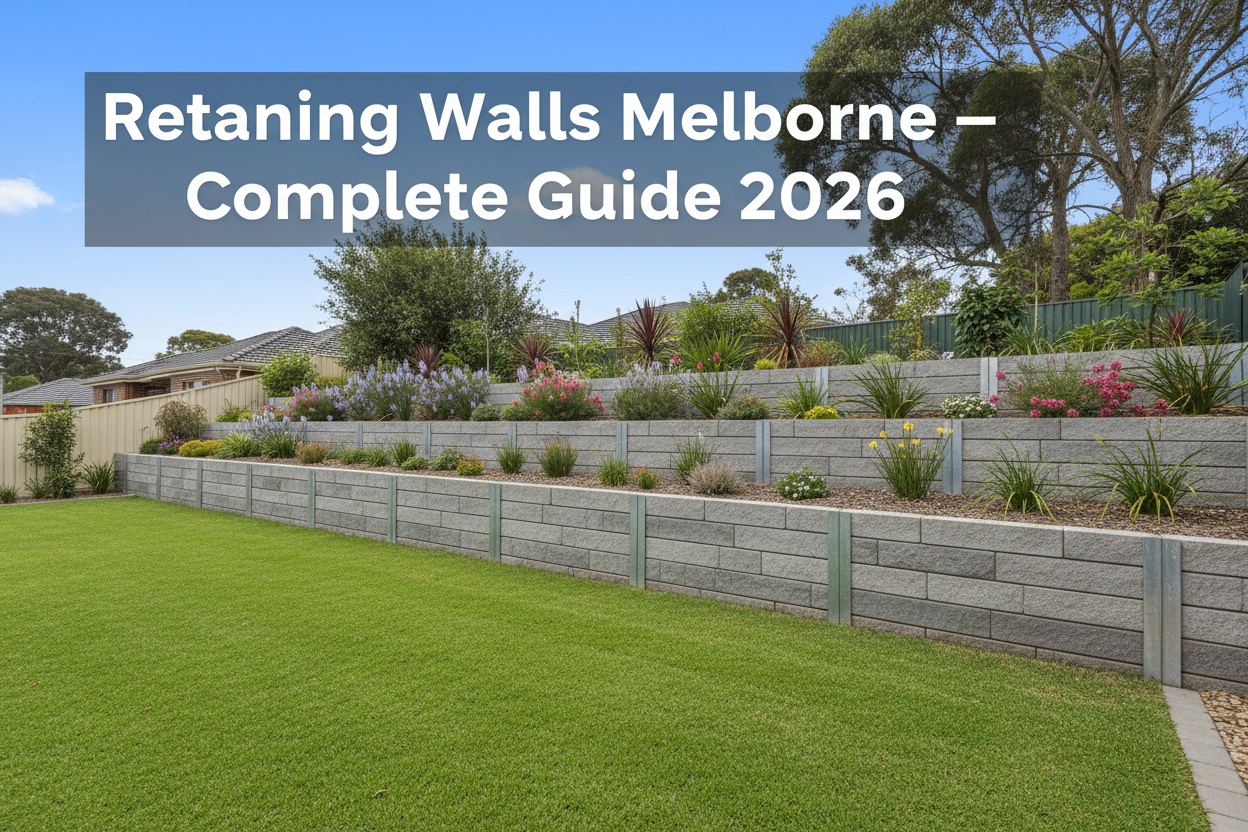

Retaining Walls Melbourne — What You Need to Know in 2026
Melbourne is built on some of the most reactive clay soils in Australia. The Coode Island Silt of the inner west, the highly reactive Silurian clay of the eastern suburbs, and the basalt plains of the north and west create retaining wall challenges that catch out builders and homeowners who don't understand local soil conditions. Add in Victoria's building permit requirements and Melbourne's variable rainfall, and getting your retaining wall right requires local knowledge and correct material specification. This guide covers everything Melbourne homeowners, landscapers, and builders need to know.
Written by Lee Bradley, with 40+ years of hands-on experience building retaining walls across Victoria and Australia.
Melbourne Soil Types — What's Under Your Block?
Reactive Silurian Clay — Eastern Suburbs (Box Hill, Doncaster, Ringwood, Knox)
Melbourne's eastern suburbs sit on highly reactive Silurian clay — one of the most reactive soil types in Australia. This clay expands dramatically when wet and shrinks significantly when dry, placing extreme cyclic lateral loads on retaining wall structures. For Silurian clay sites in Melbourne's east:
- Specify 50MPa concrete sleepers for all walls without exception
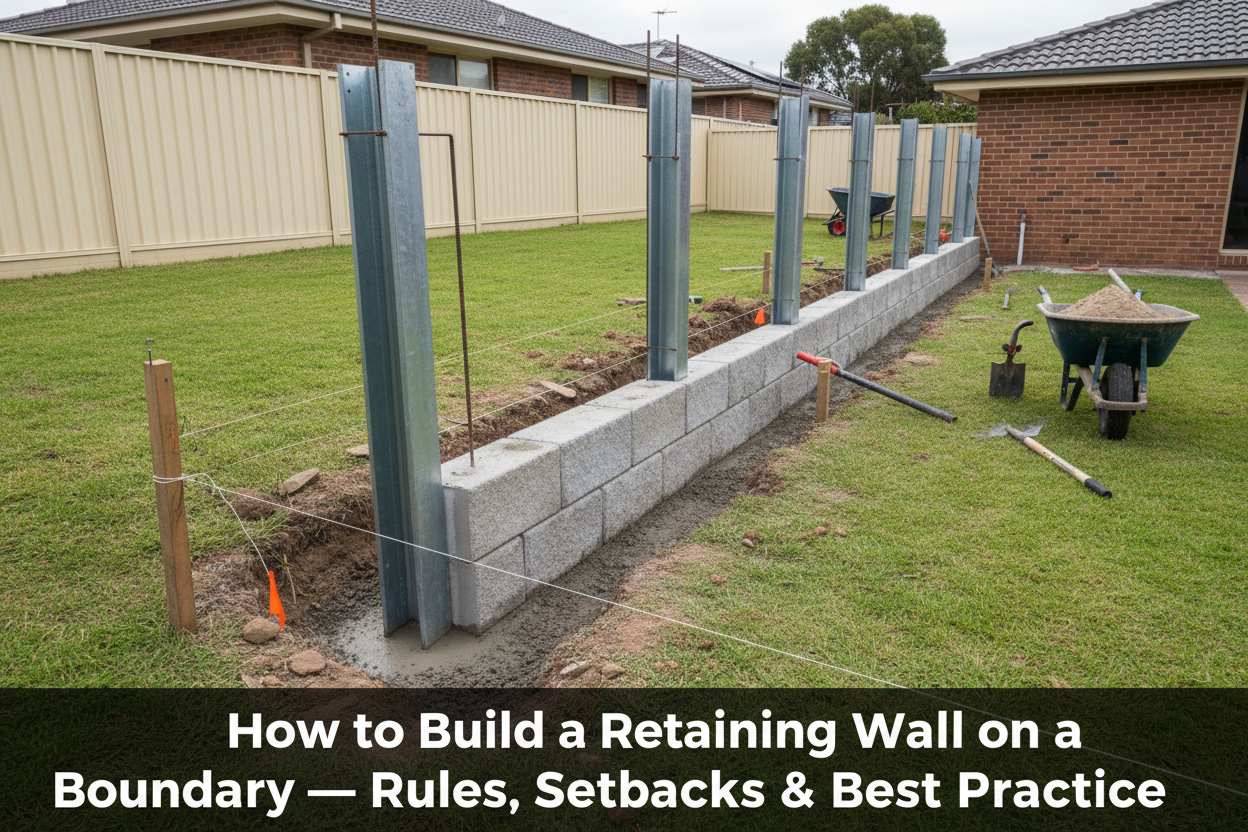
- Specify H-Beam (UC) steel posts for all walls, regardless of height
- Increase post embedment depth by a minimum of 25% over standard residential requirements
- Install drainage behind the wall to manage seasonal water pressure
Basalt Plains — Northern & Western Suburbs (Broadmeadows, Sunshine, Werribee)
Melbourne's northern and western suburbs sit on the Newer Volcanic Plains — basalt rock overlaid with reactive clay. Post holes in basalt areas require rock-breaking equipment and concrete backfill. The clay component means H-Beam posts are recommended for all walls over 800mm. Basalt rock can make post installation significantly more expensive than sandy or clay-only sites.
Coode Island Silt — Inner West (Footscray, Yarraville, Williamstown)
Melbourne's inner western suburbs sit on Coode Island Silt — a soft, compressible marine deposit that requires careful engineering for any retaining wall construction. Walls in Coode Island Silt areas should always be engineer-specified, regardless of height. Standard residential specifications are not appropriate for these conditions.
Sandy Soils — Mornington Peninsula & Bayside (Frankston, Mornington, Brighton)
Melbourne's bayside and Mornington Peninsula suburbs generally sit on sandy soils with good drainage. Standard 40MPa concrete sleepers and C-Channel steel posts are appropriate for walls under 1.0m in these conditions.
Choosing the Right Concrete Sleepers for Melbourne
40MPa Concrete Sleepers
40MPa concrete sleepers are the standard residential specification for Melbourne retaining walls in stable, well-drained sandy soils. Suitable for bayside and Mornington Peninsula suburbs for walls under 1.0m with no surcharge load. Available in charcoal, woodgrain, and smooth finish.
50MPa Concrete Sleepers
50MPa concrete sleepers are the recommended specification for all Melbourne retaining walls on reactive Silurian clay, basalt plains, and Coode Island Silt, walls over 1.0m, and all engineer-specified designs. In practice, 50MPa is the correct specification for the majority of Melbourne retaining wall projects.
Choosing the Right Steel Posts for Melbourne
C-Channel (PFC) Posts
C-Channel steel posts are suitable for Melbourne retaining walls under 1.0m in stable, well-drained sandy soils in bayside and Mornington Peninsula suburbs. For most Melbourne sites on reactive clay or basalt, H-Beam is the correct specification.
H-Beam (UC) Posts
H-Beam steel posts are the recommended specification for all Melbourne retaining walls on reactive Silurian clay, basalt plains, walls over 1.0m, and all engineer-specified designs. If you're building in Box Hill, Doncaster, Ringwood, Knox, Broadmeadows, Sunshine, or Werribee — specify H-Beam regardless of wall height.
Victorian Building Permit Requirements
In Victoria, retaining walls are regulated under the Building Act 1993 and the Building Regulations 2018. Key requirements for Melbourne retaining walls:
- Retaining walls over 1.0m in height require a building permit from a Registered Building Surveyor
- All walls requiring a building permit must be designed by a Registered Engineer
- Owner-builders may construct retaining walls under certain thresholds — check with the Victorian Building Authority
- Walls near boundaries may require a report and consent from the relevant council
- All retaining walls must comply with AS 4678-2002 Earth Retaining Structures
Always check with your local council and a Registered Building Surveyor before commencing work. See our full Retaining Wall Regulations — State-by-State Guide.
How Much Does a Retaining Wall Cost in Melbourne?
- DIY supply-only (materials): $190–$360 per lineal metre for a standard 1.0m wall with concrete sleepers and steel posts
- Installed by a landscaper (no engineer): $500–$850 per lineal metre for a standard 1.0m wall
- Engineer-specified wall over 1.0m: $950–$1,700+ per lineal metre including engineering, permit, and installation
For a detailed cost breakdown, see our Retaining Wall Cost Guide Australia 2026.
Drainage — Critical for Melbourne Retaining Walls
Melbourne's variable rainfall and highly reactive clay soils make drainage behind retaining walls absolutely critical. Saturated Silurian clay can exert lateral pressures far beyond what standard residential retaining walls are designed to handle. Every Melbourne retaining wall must include:
- Coarse gravel or crushed rock backfill directly behind the wall (minimum 300mm wide)
- Slotted agricultural drain pipe at the base of the wall, discharging to a legal point of discharge
- Geotextile fabric between the gravel backfill and native soil to prevent fines migration
- Weep holes through the wall face at regular intervals as a secondary drainage measure
See our full guide: How to Install Drainage Behind a Retaining Wall.
Shop Retaining Wall Materials — Melbourne VIC
- All Concrete Sleepers — Melbourne VIC
- 40MPa Concrete Sleepers — Melbourne VIC
- 50MPa Concrete Sleepers — Melbourne VIC
- Retaining Wall Steel Posts — Melbourne VIC
- H-Beam Steel Posts — Melbourne VIC
- C-Channel Steel Posts — Melbourne VIC
- Fence Brackets — Melbourne VIC