

Retaining Walls Gold Coast — What You Need to Know in 2026
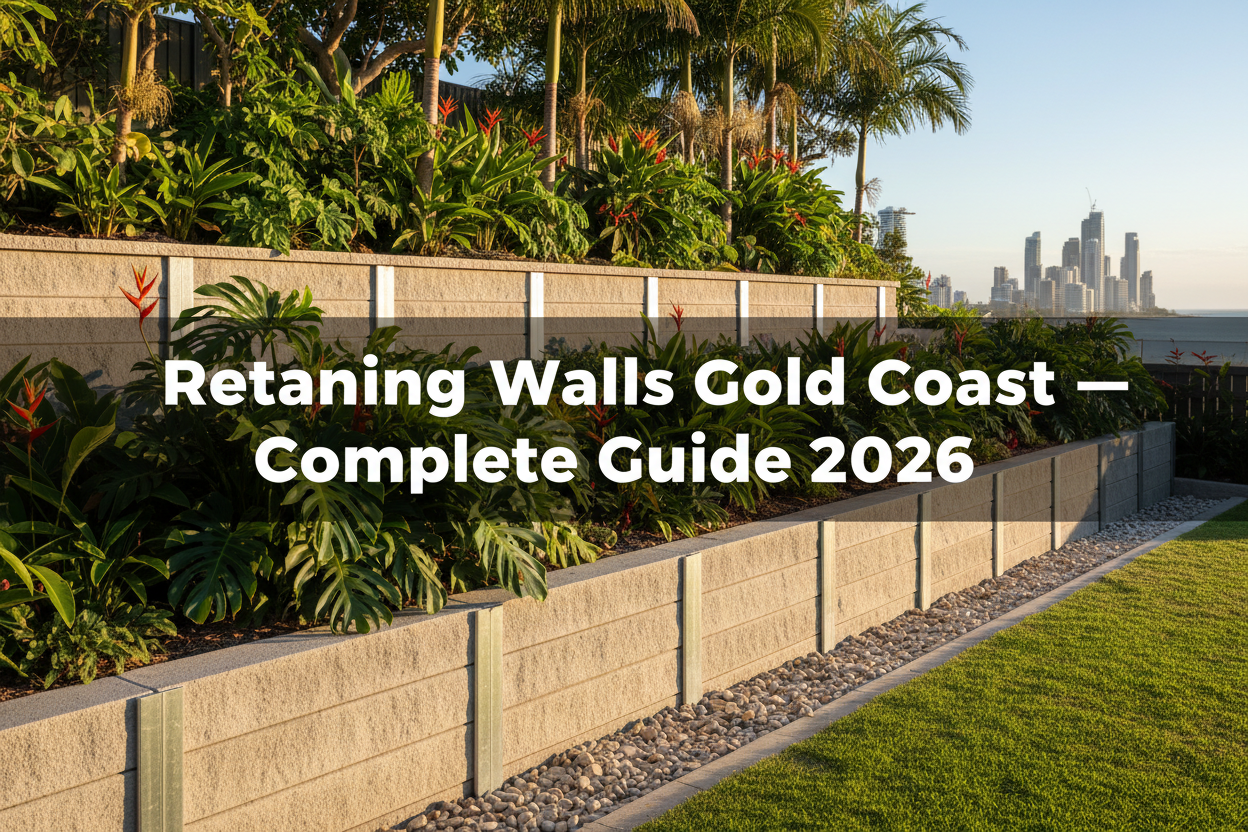
Building a retaining wall on the Gold Coast is not a one-size-fits-all exercise. The Gold Coast's diverse geology — from the sandy coastal strip to the reactive Oxley Clay of the western growth corridors and the steep basalt terrain of the hinterland — means that the materials, post specification, and engineering requirements for a retaining wall in Surfers Paradise are fundamentally different from those for a wall in Coomera or Tamborine Mountain. This guide covers everything Gold Coast homeowners, landscapers, and builders need to know to get their retaining wall right the first time.
Written by Lee Bradley, with 40+ years of hands-on experience building retaining walls across Queensland and Australia.
Gold Coast Soil Types — What's Under Your Block?
Understanding your soil type is the single most important factor in specifying a Gold Coast retaining wall correctly. Get it wrong and you'll be rebuilding within a decade.
Coastal Strip — Tamala Sand (Coolangatta to Southport)
The Gold Coast's coastal strip from Coolangatta to Southport sits on deep Tamala Sand — a well-drained, low-plasticity sandy soil that places minimal lateral pressure on retaining wall structures. This is the most forgiving soil condition on the Gold Coast for retaining wall construction. Standard 40MPa concrete sleepers and C-Channel steel posts are appropriate for walls under 1.0m in these conditions. Post holes are easy to excavate but may require concrete backfill to achieve adequate embedment in loose sand.
Western Growth Corridors — Reactive Oxley Clay (Coomera, Pimpama, Ormeau, Yarrabilba)
The Gold Coast's fastest-growing suburbs — Coomera, Pimpama, Ormeau, and Yarrabilba — sit on reactive Oxley Clay, a high-plasticity clay that expands significantly during Queensland's wet season and contracts in the dry. This cyclic movement places substantial and repeated lateral loads on retaining wall structures that standard residential specifications cannot handle over the long term. For these areas:
- Specify 50MPa concrete sleepers for all walls
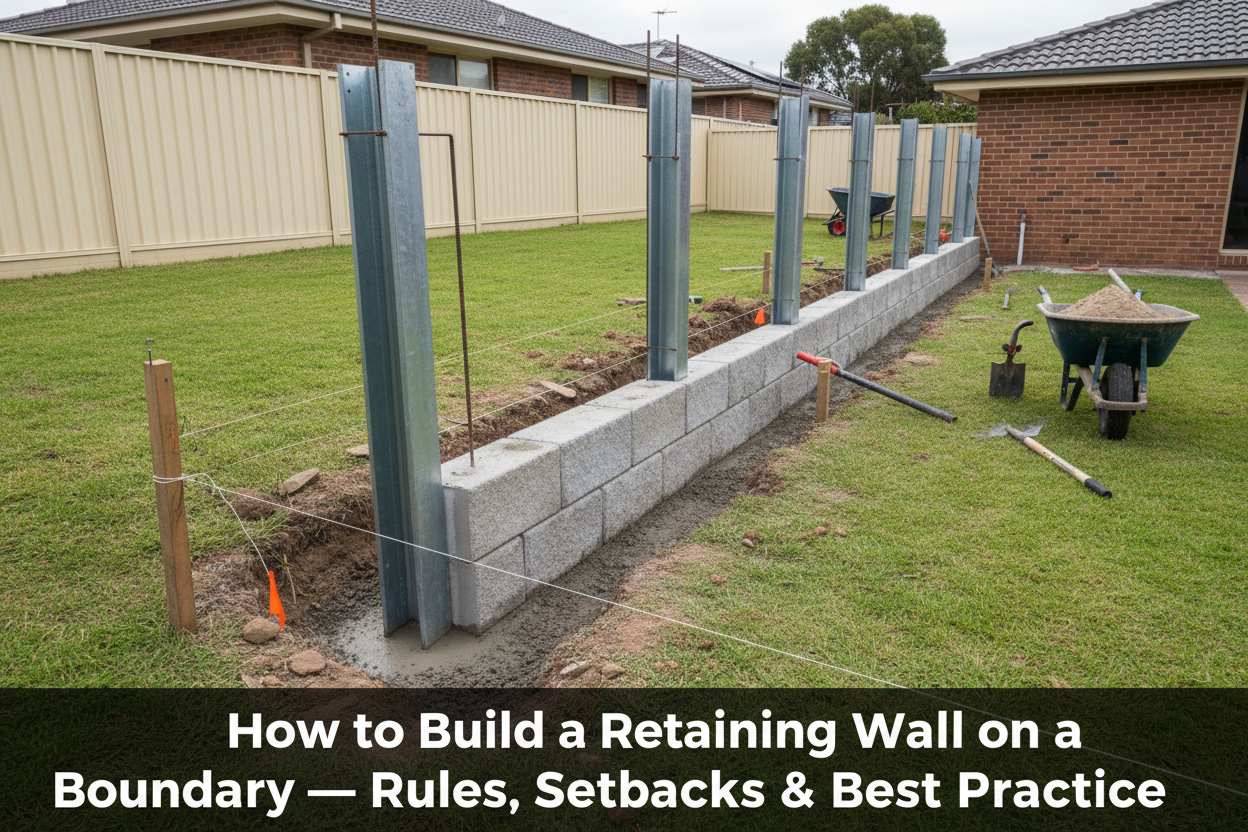
- Specify H-Beam (UC) steel posts for all walls, regardless of height
- Increase post embedment depth by a minimum of 20% over standard residential requirements
- Install drainage behind the wall to manage wet season water pressure
Hinterland — Basalt & Clay (Tamborine Mountain, Canungra, Springbrook)
The Gold Coast hinterland presents the most challenging retaining wall conditions on the Gold Coast. Steep terrain, high rainfall, and a mix of basalt rock and clay soils create significant lateral earth pressure. All hinterland retaining walls should be engineer-specified, and walls over 1.0m require QBCC building development approval regardless of location.
Choosing the Right Concrete Sleepers for the Gold Coast
40MPa Concrete Sleepers
40MPa concrete sleepers are the standard residential specification for Gold Coast retaining walls in stable, well-drained ground conditions. Suitable for the coastal strip and well-drained western suburbs for walls under 1.0m with no surcharge load. Available in charcoal, woodgrain, and smooth finish.
50MPa Concrete Sleepers
50MPa concrete sleepers are the heavy duty specification for reactive clay sites, walls over 1.0m, and all engineer-specified designs. The preferred specification for Coomera, Pimpama, Ormeau, Yarrabilba, and all Gold Coast hinterland projects.
75mm vs 100mm Sleepers
75mm sleepers are the standard residential thickness for walls up to approximately 1.2m. 100mm (heavy duty) sleepers are specified for walls over 1.2m, driveway walls with vehicle surcharge, and all engineer-specified designs. See our full guide: 75mm vs 100mm Concrete Sleepers — Which Should You Choose?
Choosing the Right Steel Posts for the Gold Coast
C-Channel (PFC) Posts
C-Channel steel posts are the standard residential post for Gold Coast retaining walls under 1.0m in stable, well-drained sandy soils. Suitable for the coastal strip from Coolangatta to Southport where Tamala Sand provides good drainage and low lateral pressure.
H-Beam (UC) Posts
H-Beam steel posts are the structural specification for walls over 1.0m, reactive clay sites in the western growth corridors, and all engineer-specified designs. The H-Beam's superior section modulus handles the cyclic lateral loads imposed by reactive Oxley Clay through Queensland's wet and dry seasons. If you're building in Coomera, Pimpama, Ormeau, or Yarrabilba — specify H-Beam regardless of wall height.
Gold Coast Council Approval Requirements
In Queensland, retaining walls are regulated under the Planning Act 2016 and the Building Act 1975. Key requirements for Gold Coast retaining walls:
- Walls over 1.0m in height require a building development approval (BDA) from Gold Coast City Council
- All walls requiring BDA must be designed by a Registered Professional Engineer of Queensland (RPEQ)
- Licensed builder required for walls requiring BDA under QBCC regulations
- Walls near boundaries may require neighbour notification regardless of height
- All retaining walls must comply with AS 4678-2002 Earth Retaining Structures
Always check with Gold Coast City Council before commencing work. See our full Retaining Wall Regulations — State-by-State Guide.
How Much Does a Retaining Wall Cost on the Gold Coast?
Gold Coast retaining wall costs vary significantly based on wall height, length, soil conditions, and whether engineer certification is required. As a general guide for 2026:
- DIY supply-only (materials): $180–$350 per lineal metre for a standard 1.0m wall with concrete sleepers and steel posts
- Installed by a landscaper (no engineer): $450–$750 per lineal metre for a standard 1.0m wall
- Engineer-specified wall over 1.0m: $800–$1,500+ per lineal metre including engineering, approval, and installation
For a detailed cost breakdown, see our Retaining Wall Cost Guide Australia 2026.
Drainage — The Most Overlooked Part of Any Gold Coast Retaining Wall
Queensland's wet season delivers intense rainfall events that saturate the soil behind retaining walls and dramatically increase lateral water pressure. A retaining wall without adequate drainage will fail — it's not a matter of if, but when. Every Gold Coast retaining wall should include:
- Coarse gravel or crushed rock backfill directly behind the wall (minimum 300mm wide)
- Slotted agricultural drain pipe at the base of the wall, discharging to a legal point of discharge
- Geotextile fabric between the gravel backfill and native soil to prevent fines migration
- Weep holes through the wall face at regular intervals as a secondary drainage measure
See our full guide: How to Install Drainage Behind a Retaining Wall.
Shop Retaining Wall Materials — Gold Coast QLD
- All Concrete Sleepers — Gold Coast QLD
- 40MPa Concrete Sleepers — Gold Coast QLD
- 50MPa Concrete Sleepers — Gold Coast QLD
- Retaining Wall Steel Posts — Gold Coast QLD
- H-Beam Steel Posts — Gold Coast QLD
- C-Channel Steel Posts — Gold Coast QLD
- Fence Brackets — Gold Coast QLD
- Concrete Under Fence Plinths — Gold Coast QLD