

Weep holes are one of the simplest and most important components of a retaining wall drainage system. They cost almost nothing, take minutes to install, and provide a critical secondary drainage path that can prevent wall failure when the primary drainage system is overwhelmed or partially blocked.
Despite their simplicity, weep holes are frequently omitted, incorrectly positioned, or blocked during backfilling. This guide covers what weep holes do, where to put them, and how to keep them working.
What Are Weep Holes?
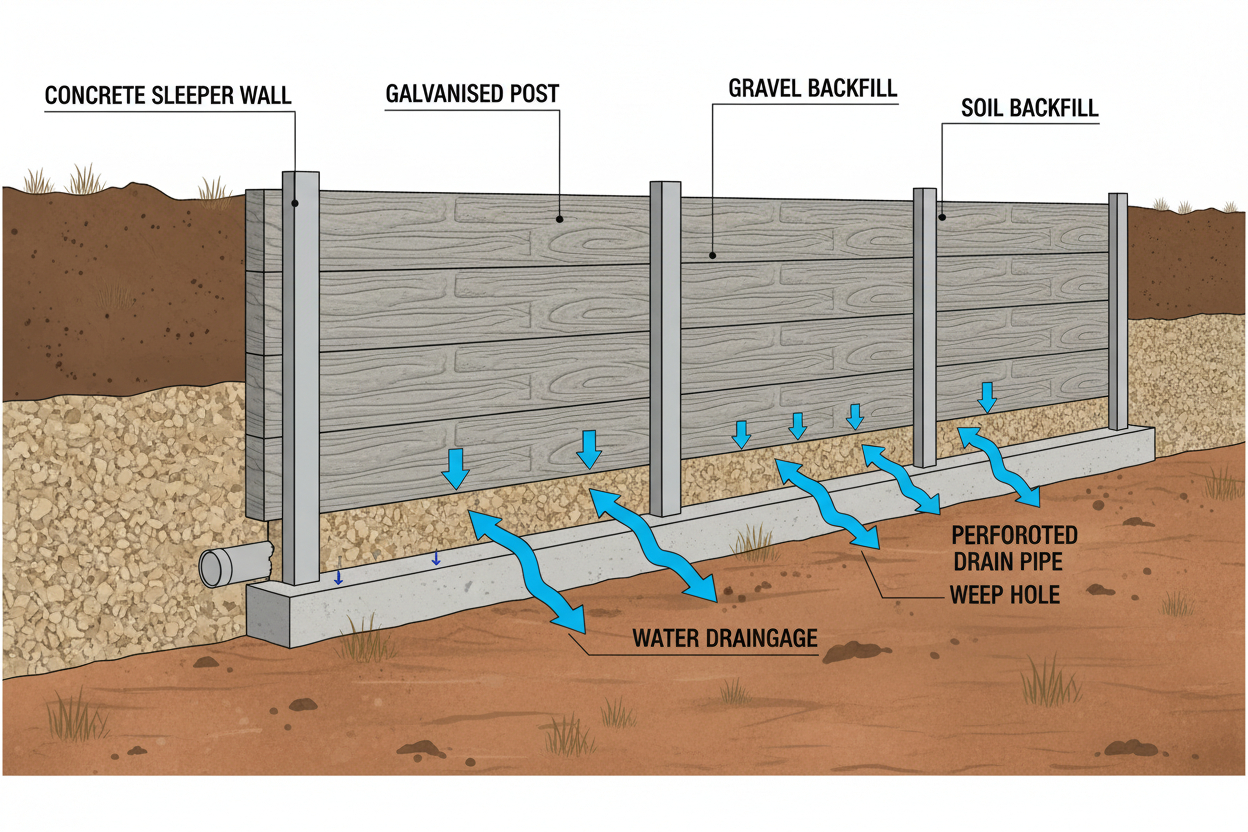
Weep holes are small openings through or between the sleepers at the base of a retaining wall that allow water to escape from behind the wall directly through the wall face. They are a secondary drainage path — the primary drainage path is the ag pipe at the base of the wall. Weep holes provide relief when the primary drainage system is overwhelmed during heavy rain, or when the ag pipe is partially blocked.
In a correctly drained retaining wall, weep holes should discharge water during and after heavy rainfall. If weep holes are never discharging water, either the primary drainage system is handling all the drainage load (which is fine), or the weep holes are blocked (which is a problem).
Why Weep Holes Matter
Even a correctly installed ag pipe and drainage aggregate system can be overwhelmed during extreme rainfall events. When the drainage aggregate becomes temporarily saturated and the ag pipe cannot carry the full drainage load, water pressure builds behind the wall. Weep holes provide a direct relief path — water escapes through the wall face rather than continuing to build pressure behind it.
Weep holes also provide a visible indicator of drainage system performance. If weep holes are discharging water long after rain has stopped, it may indicate that the primary drainage system is blocked or inadequate. If weep holes are discharging soil or fine material, it indicates the geotextile fabric behind the wall has failed or was not installed.
Where to Install Weep Holes
Height Position
Weep holes should be installed in the lowest course of sleepers, or between the first and second course. The purpose of weep holes is to allow water to escape from the base of the drainage zone — where water collects. Weep holes installed higher up the wall face are less effective because water must build up to the height of the weep hole before it can escape.
Horizontal Spacing
Weep holes should be spaced at 1.8–2.4m intervals along the wall. For a wall with posts at 1.8–2.0m centres, one weep hole per bay (between each pair of posts) is a practical spacing.
Position Within the Sleeper Course
Weep holes are typically installed:
- Between sleepers: A small gap left between adjacent sleepers in the lowest course, or a purpose-made weep hole fitting installed between sleepers.
- Through a sleeper: A hole drilled through a sleeper in the lowest course. This is less common for concrete sleepers due to the difficulty of drilling through reinforced concrete.
- Purpose-made weep hole fittings: Small plastic or PVC fittings designed to be installed between sleepers to create a controlled weep hole opening. These are the most common approach for concrete sleeper walls. Included in our drainage kits.
How Many Weep Holes Do I Need?
As a general guide:
- One weep hole per 1.8–2.4m of wall length
- For a 10m wall: 4–6 weep holes
- For a 20m wall: 8–12 weep holes
- For walls in heavy clay soils or high-rainfall areas: use the closer spacing (1.8m)
- For walls in sandy soils or low-rainfall areas: 2.4m spacing is generally adequate
How to Install Weep Holes
- Plan weep hole positions before installing the lowest sleeper course. Mark the positions on the posts at the planned weep hole locations.
- Install purpose-made weep hole fittings between sleepers in the lowest course as the sleepers are installed. Position the fitting so it aligns with the drainage aggregate zone behind the wall.
- Ensure the weep hole opening faces outward through the wall face and is not obstructed by the sleeper or post.
- Do not block weep holes during backfilling. When backfilling behind the wall, ensure the drainage aggregate extends to the weep hole openings. Do not allow soil to cover or block the weep holes from behind.
- Check weep holes are clear after backfilling. Inspect each weep hole from the front of the wall to confirm it is open and unobstructed.
Maintaining Weep Holes
Weep holes require periodic inspection and maintenance to remain effective:
- Inspect annually and after major rainfall events.
- Clear any blockages — soil, plant roots, debris, or insect nests can block weep holes over time. Use a thin rod or wire to clear blockages.
- Check for soil discharge. If soil or fine material is washing out through weep holes, the geotextile fabric behind the wall may have failed. This requires investigation.
- Check for discharge during rain. Weep holes that are not discharging during heavy rain may be blocked. Investigate and clear any blockage.
Frequently Asked Questions
Do all retaining walls need weep holes?
Yes. Weep holes are a standard component of retaining wall drainage systems. They provide a secondary drainage path and a visible indicator of drainage system performance. All retaining walls should have weep holes installed in the lowest course.
How big should weep holes be?
Purpose-made weep hole fittings are typically 50–75mm in diameter or equivalent opening size. This is large enough to allow water to escape freely but small enough to prevent significant soil loss through the opening.
My weep holes are discharging soil — is that a problem?
Yes. Soil discharging through weep holes indicates that the geotextile fabric behind the wall has failed or was not installed, allowing soil to migrate into the drainage zone and through the weep holes. This requires investigation by a retaining wall specialist. Over time, soil loss through weep holes can undermine the backfill behind the wall.
Can I add weep holes to an existing retaining wall?
Yes, in some cases. For concrete sleeper walls, weep hole fittings can sometimes be installed between existing sleepers without demolishing the wall. For walls where the sleepers are tightly fitted, adding weep holes may require removing and reinstalling the lowest course of sleepers. Contact a retaining wall specialist to assess the options for your specific wall.
Order Weep Holes and Drainage Kits
Weep hole fittings are included in our complete drainage kits, which also include ag pipe and geotextile fabric. Or contact our team to discuss drainage requirements for your project.