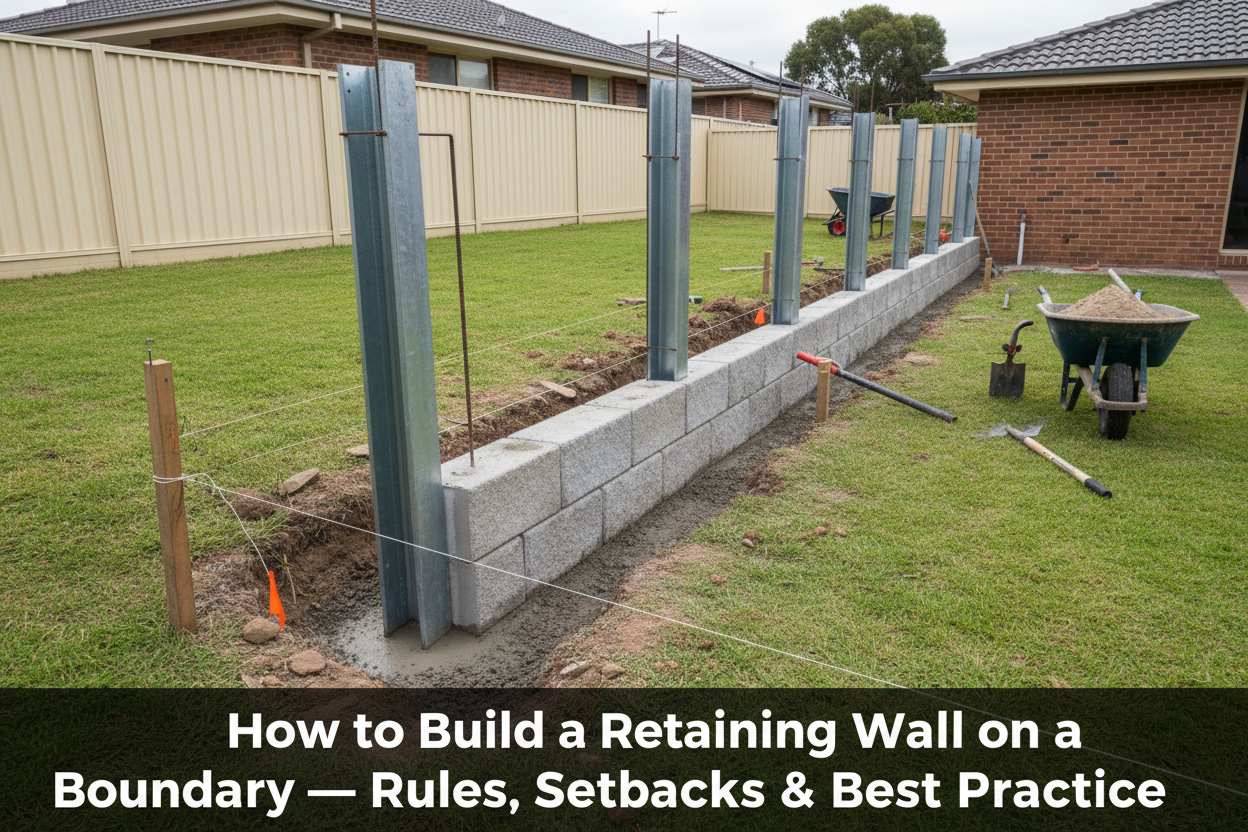


Post embedment depth is one of the most critical — and most commonly underestimated — variables in retaining wall construction. A post that isn't deep enough will rotate under soil pressure, causing the wall to lean, bow, and eventually fail. And because the failure occurs below ground, there's often no visible warning until the wall is already moving.
This guide covers the standard embedment depth rules, the factors that require greater depth, and how to select the right post length for your wall.
The One-Third Rule
The standard rule of thumb for retaining wall post embedment in Australia is that the in-ground portion should be at least one-third of the total post length. This gives:
- 1.5m post — minimum 500mm in the ground (1.0m above ground)
- 1.8m post — minimum 600mm in the ground (1.2m above ground)
- 2.1m post — minimum 700mm in the ground (1.4m above ground)
- 2.4m post — minimum 800mm in the ground (1.6m above ground)
- 2.7m post — minimum 900mm in the ground (1.8m above ground)
- 3.0m post — minimum 1000mm in the ground (2.0m above ground)
This is a minimum guide for standard residential conditions in non-aggressive soils without surcharge loads. In many real-world conditions, greater embedment is required.
Selecting the Right Post Length
To select the correct post length, work backwards from your required wall height:
Minimum post length = Wall height ÷ 0.67
Then round up to the next available post length in our range.
Examples:
- Wall height 800mm: 800 ÷ 0.67 = 1.19m → order 1.5m posts
- Wall height 1.0m: 1000 ÷ 0.67 = 1.49m → order 1.5m posts (minimum) or 1.8m for clay soil margin
- Wall height 1.2m: 1200 ÷ 0.67 = 1.79m → order 1.8m posts
- Wall height 1.5m: 1500 ÷ 0.67 = 2.24m → order 2.4m posts
- Wall height 1.8m: 1800 ÷ 0.67 = 2.69m → order 2.7m or 3.0m posts
In clay soils or near boundaries, always order the next post length up from the minimum calculation to provide additional embedment margin.
Factors That Require Greater Embedment Depth
Heavy clay soils
Clay soils exert significantly more lateral pressure on posts than sandy soils. In heavy clay, increase the embedment depth by 100–200mm beyond the one-third minimum. This typically means ordering the next post length up from the minimum calculation. See our guide on how soil type affects your wall.
Surcharge loads
Driveways, vehicle parking, or structures above the wall increase the overturning moment on each post, requiring greater embedment depth. Engineering sign-off is required for walls with surcharge loads. See our guide on surcharge loads.
Taller walls
The one-third rule provides a minimum embedment for standard conditions. For walls over 1.0m, the embedment depth should be confirmed by a structural engineer rather than relying on the rule of thumb alone.
Proximity to boundaries or structures
Walls near boundaries or structures typically require engineering certification, which will specify the required embedment depth for the specific site conditions.
Wider post spacing
Wider post spacing increases the load on each post, which may require deeper embedment to resist the increased overturning moment. See our guide on post spacing.
What Happens If Posts Aren't Deep Enough?
A post that is too shallow will rotate under soil pressure. The rotation starts slowly — often imperceptibly — and accelerates as the wall leans further and the soil pressure increases. Once a post starts rotating, the wall is failing. The failure mode is typically:
- Post rotates at ground level, causing the wall face to lean outward
- Sleepers shift and gaps open between courses
- Soil begins to migrate through the gaps
- Wall collapses, often suddenly
This failure sequence can take months or years to develop, which is why inadequate embedment depth is often not identified until the wall is already significantly compromised.
Embedment in Rock or Hard Subgrade
If rock is encountered before the required embedment depth is reached, the post footing design must be modified. Options include:
- Drilling into the rock and grouting the post (requires specialist equipment)
- Using a larger diameter footing to compensate for reduced depth (engineering assessment required)
- Redesigning the wall to work with the available embedment depth (engineering assessment required)
Do not simply stop at the rock surface and assume the post is adequately embedded. Rock surface embedment without drilling provides minimal lateral restraint. See our guide on retaining wall footings for more detail on footing design.
Frequently Asked Questions
How deep should a 1.8m retaining wall post be in the ground?
A 1.8m post should have a minimum of 600mm in the ground (one-third of 1.8m), leaving 1.2m above ground. In clay soils or near boundaries, consider using a 2.1m post with 700mm embedment for additional margin.
Can I use a shorter post and just dig deeper?
The post length determines both the above-ground wall height and the in-ground embedment. You cannot use a shorter post and dig deeper — the post must be long enough to provide both the required wall height and the required embedment depth. Select the post length based on the total required length (wall height + embedment depth).
Do I need engineering to confirm embedment depth?
For walls over 1.0m, near boundaries, with surcharge loads, or in heavy clay soils, engineering sign-off on the embedment depth is strongly recommended and often legally required. See our guide on council approval requirements.
Ready to Order?
Browse our full range of C-channel posts and H-beam posts in multiple lengths, or contact our team to confirm the right post length for your wall height and soil conditions.