
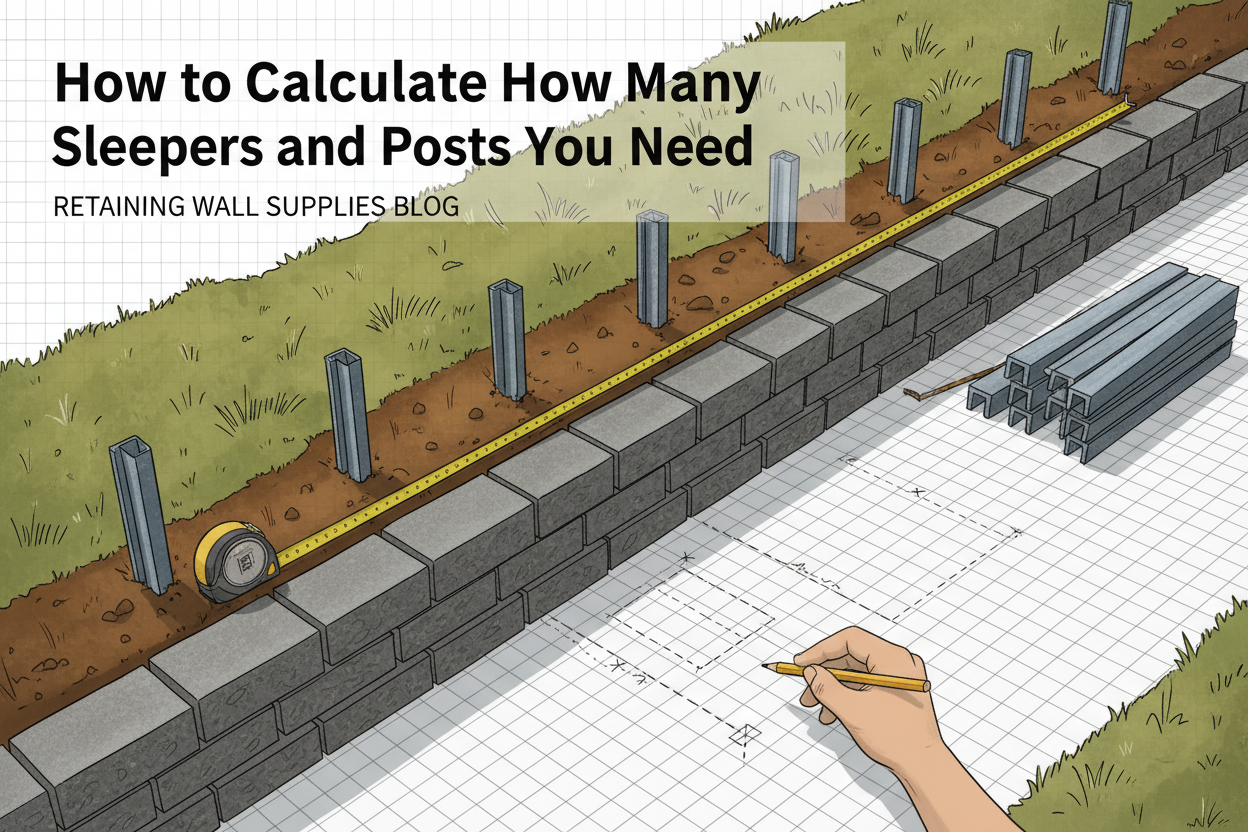

One of the most practical questions before ordering retaining wall materials is: how many sleepers and posts do I actually need? Order too few and you're waiting for a second delivery. Order too many and you're paying for materials you don't use.
This guide walks you through the calculation step by step, with worked examples for common wall configurations. For a full build walkthrough once you have your quantities, see our guide on how to build a concrete sleeper retaining wall. You can also use our dedicated retaining wall materials calculator guide for a more detailed breakdown including drainage.
How a Concrete Sleeper Retaining Wall Is Structured
Before calculating quantities, it helps to understand the basic structure:
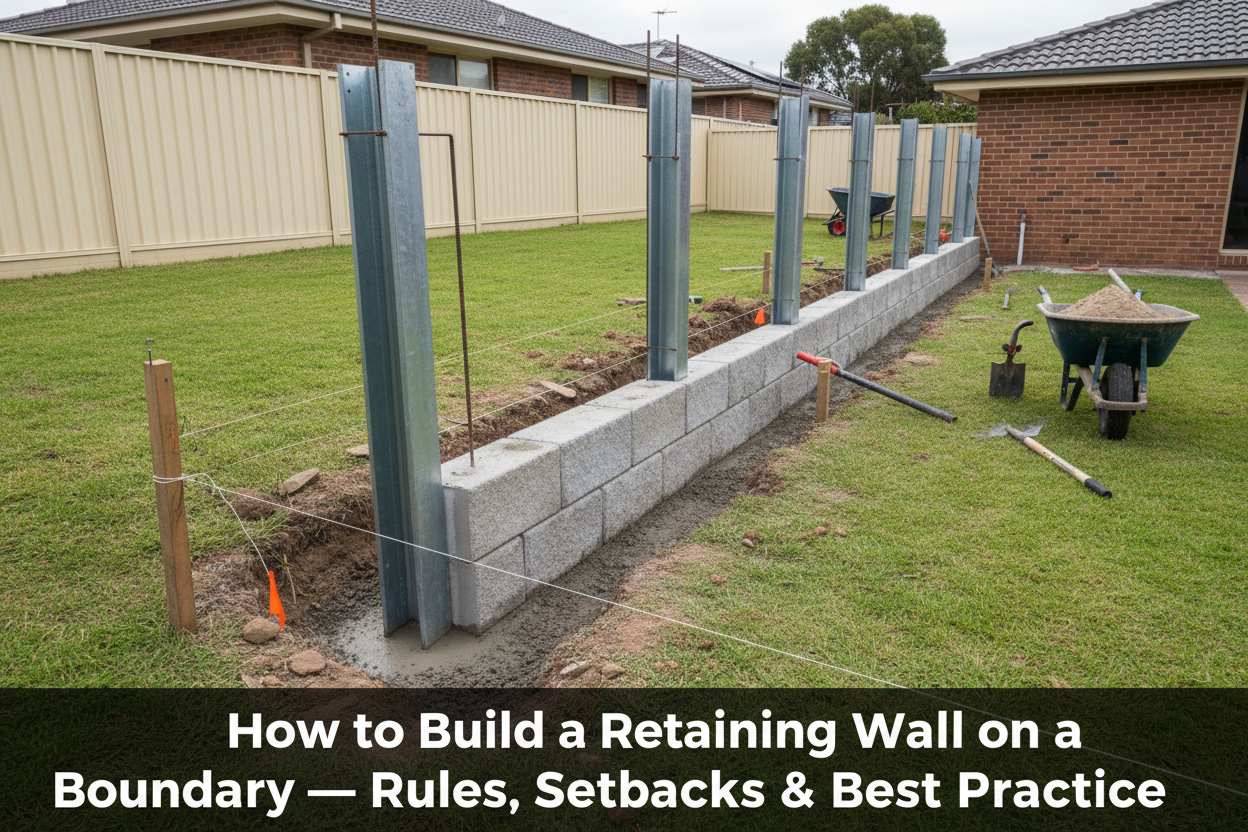
- Posts are set vertically in the ground at regular intervals (typically 1.8m–2.0m apart for standard walls). They carry the lateral load from the retained soil.
- Sleepers are laid horizontally between the posts, stacked course by course from the base of the wall to the top. Each sleeper is 2000mm long and 200mm high.
- The number of sleeper courses depends on the wall height. Each course adds 200mm of height.
- The number of posts depends on the wall length and post spacing.
Step 1 — Determine Your Wall Dimensions
You need three measurements:
- Wall length (L): The total length of the wall run in metres. Measure along the base of the wall.
- Wall height (H): The finished retained height in metres — from the base of the wall to the top of the retained soil. This is not the same as the exposed face height if the base of the wall is below ground level.
- Post spacing (S): The centre-to-centre distance between posts. Standard spacing is 1.8m–2.0m for most residential walls. Use 1.8m for clay soils or taller walls; 2.0m for sandy soils and lower walls. For walls over 1.0m, confirm post spacing with a structural engineer. See our full guide on retaining wall post spacing.
Step 2 — Calculate Number of Posts
The formula for the number of posts in a straight wall run is:
Number of posts = (Wall length ÷ Post spacing) + 1
The "+1" accounts for the post at the end of the wall. Always round up to the nearest whole number.
Example: Wall length = 10m, post spacing = 2.0m
Number of posts = (10 ÷ 2.0) + 1 = 6 posts
Example: Wall length = 15m, post spacing = 1.8m
Number of posts = (15 ÷ 1.8) + 1 = 9.33 → round up to 10 posts
Add Specialist Posts
In addition to your standard C-channel or H-beam posts, add:
- Corner posts or L-posts — one per 90-degree corner in the wall
- End posts — one per open wall termination (at a driveway edge, steps, or fence line)
- Joiner posts — where two wall runs meet in a straight line
See our corner, L-post, joiner & end post range.
Step 3 — Calculate Post Length
Post length must account for both the above-ground wall height and the in-ground embedment depth. Read our full guide on how deep retaining wall posts should be.
Minimum post length = Wall height + Embedment depth
The standard rule of thumb for embedment depth is one-third of the total post length. Working backwards:
Minimum total post length = Wall height ÷ 0.67
Example: Wall height = 1.0m
Minimum post length = 1.0 ÷ 0.67 = 1.5m (500mm in ground, 1000mm above ground)
Example: Wall height = 1.2m
Minimum post length = 1.2 ÷ 0.67 = 1.8m (600mm in ground, 1200mm above ground)
In heavy clay soils, near boundaries, or for taller walls, greater embedment depth may be required. Confirm with your structural engineer if in doubt.
Step 4 — Calculate Number of Sleeper Courses
Each sleeper course adds 200mm of wall height. The number of courses is:
Number of courses = Wall height (mm) ÷ 200
Example: Wall height = 1.0m (1000mm)
Number of courses = 1000 ÷ 200 = 5 courses
Example: Wall height = 1.2m (1200mm)
Number of courses = 1200 ÷ 200 = 6 courses
Step 5 — Calculate Number of Sleepers
Each sleeper is 2000mm (2.0m) long and spans one bay between posts. The number of sleepers per course is:
Sleepers per course = Wall length (m) ÷ 2.0
Round up to the nearest whole number (you can't use half a sleeper without cutting). Not sure which sleeper thickness you need? See our guide on 75mm vs 100mm concrete sleepers.
Total sleepers = Sleepers per course × Number of courses
Add 5–10% for cuts, waste, and corners.
Example: Wall length = 10m, wall height = 1.0m (5 courses)
Sleepers per course = 10 ÷ 2.0 = 5
Total sleepers = 5 × 5 = 25 sleepers
Add 10% waste = 28 sleepers (round up)
Example: Wall length = 15m, wall height = 1.2m (6 courses)
Sleepers per course = 15 ÷ 2.0 = 7.5 → round up to 8
Total sleepers = 8 × 6 = 48 sleepers
Add 10% waste = 53 sleepers (round up)
Step 6 — Calculate Concrete for Post Footings
Each post footing requires concrete to fill the hole around the post. A standard footing hole is approximately 300mm diameter and as deep as your embedment depth plus 100–150mm below the post base. See our guide on retaining wall footings — depth and concrete.
As a rough guide, allow approximately 0.02–0.03 cubic metres of concrete per post footing for a standard residential wall. For 10 posts, this is approximately 0.2–0.3m³ of concrete — or roughly 4–6 bags of 20kg rapid-set concrete per post.
See our concrete and cement range.
Worked Example — Complete Wall Calculation
Wall details: 12m long, 1.0m high, standard clay soil, C-channel posts at 2.0m spacing, charcoal 75mm sleepers
- Posts: (12 ÷ 2.0) + 1 = 7 posts
- Post length: 1.0m wall ÷ 0.67 = 1.5m minimum → order 1.8m posts for clay soil margin
- Sleeper courses: 1000mm ÷ 200mm = 5 courses
- Sleepers per course: 12 ÷ 2.0 = 6 sleepers
- Total sleepers: 6 × 5 = 30 sleepers + 10% = 33 sleepers
- Drainage kit: 1 kit covering 12m wall length
- Concrete: approximately 4–6 bags per post × 7 posts = 28–42 bags of rapid-set
Materials Checklist
- Charcoal concrete sleepers — or woodgrain / smooth finish
- C-channel posts or H-beam posts
- Corner, end, joiner posts as required
- Drainage kit
- Geotextile fabric
- Hardware pack
- Concrete for post footings
Frequently Asked Questions
How many sleepers do I need per metre of wall?
For a 1.0m high wall (5 courses), you need approximately 2.5 sleepers per lineal metre of wall (5 courses ÷ 2.0m sleeper length). For a 1.2m wall (6 courses), approximately 3 sleepers per lineal metre. Add 10% for waste and cuts.
How many posts do I need per metre of wall?
At 2.0m post spacing, you need approximately 0.5 posts per lineal metre of wall (plus one for the end). At 1.8m spacing, approximately 0.56 posts per lineal metre. For a 10m wall at 2.0m spacing, that's 6 posts total.
Can I use a different post spacing to reduce the number of posts?
Wider post spacing reduces the number of posts but increases the bending moment on each post — which may require you to upgrade from C-channel to H-beam posts. For walls over 1.0m, post spacing should be confirmed by a structural engineer rather than adjusted to reduce material costs.
What if my wall has corners?
At each 90-degree corner, replace one standard post with a corner post or L-post. The sleeper count at corners depends on the corner configuration — allow for some additional cuts and waste at corners (the 10% waste allowance generally covers this for simple corners). See our guide on building retaining wall corners.
Ready to Order?
Browse our full range of concrete sleepers and steel posts, or contact our team with your wall dimensions and we'll help you confirm the right quantities before you order.