

Drainage is the single most important factor in the long-term performance of a retaining wall. More retaining walls fail because of inadequate drainage than for any other reason — including wrong post size, inadequate footings, or poor construction. And unlike a post that's too small or a footing that's too shallow, drainage failure is almost always preventable.
This guide explains why drainage matters, what a correct drainage system looks like, and the most common mistakes that cause retaining walls to fail prematurely. For a full build walkthrough, see our guide on how to build a concrete sleeper retaining wall.
Why Retaining Walls Need Drainage
When it rains, water infiltrates the soil behind your retaining wall. In well-drained sandy soils, that water moves through quickly. In clay soils — which cover a large proportion of Australian residential land — water moves slowly and the soil retains moisture for extended periods.
As water saturates the soil behind the wall, it creates hydrostatic pressure — the pressure of water pushing against the back of the wall. This pressure is in addition to the lateral earth pressure the wall is already resisting from the weight of the retained soil. In heavy clay soils after significant rainfall, hydrostatic pressure can be substantial — enough to push a wall that was adequately designed for earth pressure alone well beyond its capacity. Learn more about how soil type affects your retaining wall.
The solution is to give the water a controlled path out from behind the wall before it can build up. That's what a drainage system does.
The Four Components of a Correct Retaining Wall Drainage System
1. Geotextile Filter Fabric
Geotextile filter fabric is laid against the excavated soil face before the drainage aggregate is placed. Its job is to allow water to pass through freely while preventing fine soil particles from migrating into the drainage gravel over time.
Without geotextile fabric, fine soil particles gradually wash into the drainage aggregate and block it. Once the drainage zone is silted up, it stops working — and the wall is now effectively undrained, even though a drainage system was installed. This process can take years, which is why drainage failures often appear long after the wall was built.
Geotextile fabric should be laid up the full height of the drainage zone and folded over the top of the drainage gravel before backfilling with soil above the drainage zone. See our geotextile fabric range.
2. Drainage Aggregate
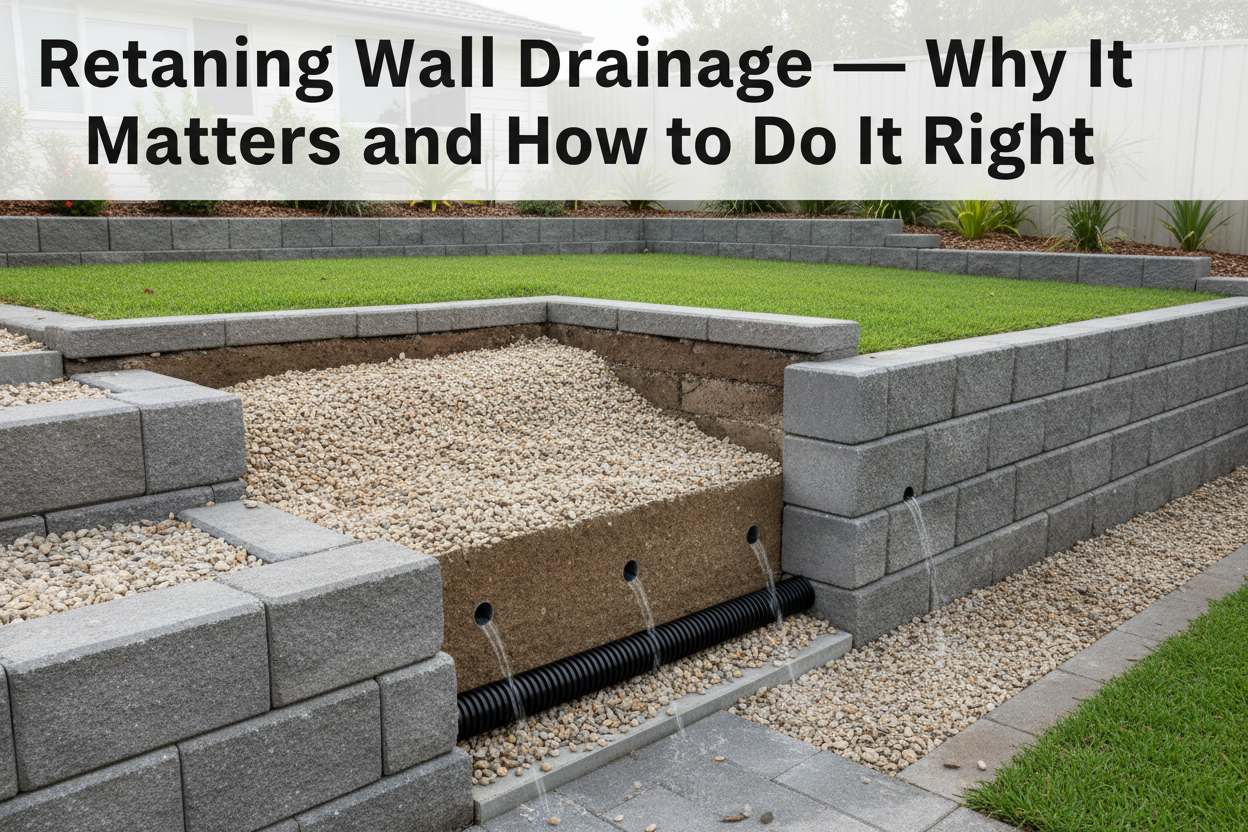
The drainage zone behind the wall should be backfilled with clean, single-sized drainage gravel — typically 20mm crushed rock or similar — for the first 300–500mm behind the sleepers. This creates a high-permeability zone that allows water to move freely down to the ag pipe at the base of the wall.
Do not use soil, clay, or mixed fill as the drainage backfill. These materials have low permeability and will not allow water to drain effectively. The drainage zone must be clean aggregate.
Drainage aggregate is typically sourced locally from a landscape or building supply yard. Your supplier can advise on the correct product for your area.
3. Agricultural Pipe (Ag Pipe)
Slotted agricultural pipe (ag pipe) is laid at the base of the wall, behind the sleepers, running the full length of the wall. Water that drains down through the drainage aggregate collects in the ag pipe and is carried to a suitable outlet.
Key requirements for ag pipe installation:
- Diameter: 100mm is standard for most residential retaining walls. Larger diameter may be required for long walls or high-rainfall sites. See our guide on ag pipe for retaining walls.
- Wrapping: The ag pipe should be wrapped in geotextile sock (filter sock) to prevent silt from entering and blocking the pipe over time. Most ag pipe is available pre-wrapped.
- Fall: The ag pipe must have a continuous fall to drain — it cannot sit flat or have low points where water pools. A minimum fall of 1:100 (1cm per metre) is generally recommended.
- Outlet: The ag pipe must connect to a suitable outlet — a stormwater pit, a daylight outlet at the end of the wall, or a sump. Water collected by the ag pipe has to go somewhere.
See our drainage kits which include ag pipe, geotextile fabric, and weep holes in one order.
4. Weep Holes
Weep holes are installed through or between sleepers at the base of the wall, providing a secondary drainage path at the wall face. They allow water that has built up in the drainage zone to escape directly through the wall face rather than continuing to build pressure. See our full guide on retaining wall weep holes.
Weep holes should be:
- Installed in the lowest course of sleepers, or between the first and second course
- Spaced at 1.8–2.4m intervals along the wall
- Kept clear of soil and debris — a blocked weep hole provides no drainage benefit
Weep holes are included in our drainage kits.
How to Install Retaining Wall Drainage — Step by Step
- After posts are set and concrete has cured, lay geotextile filter fabric against the excavated soil face behind where the sleepers will sit. The fabric should extend from the base of the excavation to the top of the intended drainage zone (typically the full height of the wall).
- Place the ag pipe at the base of the wall, behind where the sleepers will sit, with the slots facing down or to the sides (not up, where soil can fall in). Ensure the pipe has a continuous fall to its outlet.
- Install the sleepers course by course, installing weep holes in the lowest course as you go.
- Backfill behind the sleepers with clean drainage aggregate (20mm crushed rock) for the first 300–500mm. Do not use soil in this zone.
- Fold the geotextile fabric over the top of the drainage aggregate before backfilling with soil above the drainage zone. This prevents soil from migrating down into the aggregate from above.
- Backfill with soil above the drainage zone in compacted layers of 200–300mm.
- Confirm the ag pipe outlet is clear and draining before completing the backfill. Run a hose into the drainage zone and check that water exits at the outlet.
The Most Common Retaining Wall Drainage Mistakes
No drainage at all
The most common mistake. Many DIY retaining walls are built without any drainage system. The wall may perform adequately for a few years, but once the soil behind it becomes saturated — after a wet season, a burst pipe, or a change in site drainage — the hydrostatic pressure builds and the wall fails. This is not a question of if; it's a question of when.
Drainage aggregate replaced with soil
Using soil or mixed fill as the drainage backfill instead of clean aggregate. Soil has low permeability and will not drain effectively. The drainage zone must be clean, single-sized aggregate.
No geotextile fabric
Installing ag pipe and drainage aggregate without geotextile fabric. Without the fabric, fine soil particles gradually migrate into the drainage aggregate and block it. The drainage system appears to be installed correctly but silts up over time and stops working.
Ag pipe with no fall or no outlet
Ag pipe that sits flat or has no connection to a suitable outlet. Water collects in the pipe but has nowhere to go — the pipe fills up and the drainage system stops working. Every ag pipe installation must have a continuous fall and a clear outlet.
Weep holes blocked or omitted
Weep holes installed but then covered by backfill, or omitted entirely. Weep holes are a secondary drainage path — they provide relief when the primary drainage system is overwhelmed or partially blocked. They should be kept clear and inspected periodically.
Drainage installed after the wall is built
Drainage must be installed as the wall is built — not as an afterthought once the sleepers are in. Retrofitting drainage to a completed retaining wall typically requires partial or full demolition of the wall. Install the drainage system before the sleepers go in.
Drainage in Different Soil Types
Sandy soils
Sandy soils drain well naturally, which reduces (but does not eliminate) the risk of hydrostatic pressure build-up. Drainage is still required — even in sandy soils, concentrated rainfall or site drainage changes can create localised water build-up behind the wall.
Clay soils
Clay soils retain water and drain slowly. In heavy clay — common across western Sydney, Brisbane's western suburbs, Melbourne's eastern and inner suburbs, and many regional areas — drainage is critical. The drainage zone should be generous (400–500mm of aggregate behind the sleepers), the ag pipe should be correctly sized and graded, and weep holes should be installed at close intervals. In heavy clay conditions, consider increasing the drainage aggregate depth and confirming the drainage design with a professional.
High-rainfall sites
Sites in high-rainfall areas (Queensland's wet season, coastal NSW, Victoria's Dandenong Ranges and Yarra Valley) place greater demands on drainage systems. Ensure the ag pipe is correctly sized for the catchment area and that the outlet has adequate capacity to handle peak flow.
Drainage Products
- Retaining wall drainage kits — ag pipe, geotextile fabric, and weep holes in one order
- Geotextile fabric & wall liners — available separately for larger drainage zones
Frequently Asked Questions
Do all retaining walls need drainage?
Yes. All retaining walls — regardless of height, material, or soil type — benefit from drainage. For walls over 500–600mm in height, drainage is not optional; it's a fundamental part of the wall system. Omitting drainage is the most common cause of retaining wall failure in Australia.
What size ag pipe do I need for a retaining wall?
100mm diameter slotted ag pipe is standard for most residential retaining walls. For long walls (over 20–30m), high-rainfall sites, or large catchment areas, confirm the pipe size with a drainage engineer or hydraulic consultant.
Where does the ag pipe drain to?
The ag pipe must connect to a suitable outlet — a stormwater pit, a daylight outlet at the end of the wall, or a sump. It cannot simply terminate in the ground. Check with your local council about stormwater connection requirements before installing.
How often should I check my retaining wall drainage?
Inspect weep holes annually and after major rainfall events. Clear any soil or debris blocking the weep holes. If weep holes are not discharging water during or after heavy rain, the drainage system may be partially blocked and should be investigated.
Can I add drainage to an existing retaining wall?
Retrofitting drainage to a completed retaining wall is difficult and typically requires partial or full demolition of the wall to access the drainage zone. If your existing wall has no drainage and is showing signs of movement or bulging, contact a structural engineer or retaining wall specialist for an assessment before attempting repairs. See our guide on diagnosing and fixing retaining wall drainage problems.
Ready to Order Your Drainage Materials?
Our drainage kits include everything you need — ag pipe, geotextile fabric, and weep holes — in one order. Geotextile fabric is also available separately for larger drainage zones. Or contact our team to confirm the right drainage specification for your project.